
Trapezium Area Demonstration: Rotation and Definite Integral Visualization
Loading the math board and drawing, please wait…
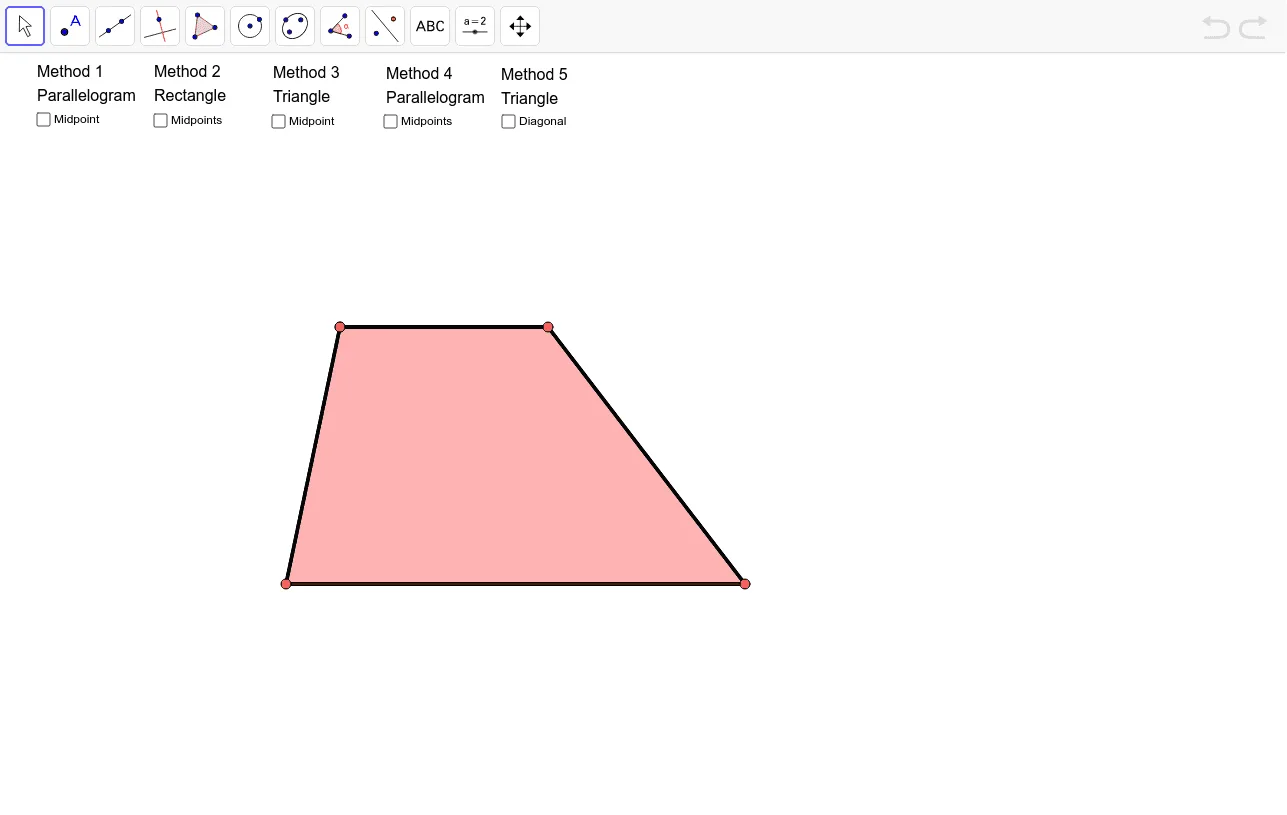
① This example dynamically demonstrates the derivation of the trapezium area formula through rotation and reassembly, linking it to the concept of definite integrals. ② Core mathematical concepts include trapezium area, polygon rotation, midpoints, definite integrals, function graphs, and area invariance under transformation. ③ Construction highlights: using GeoGebra commands such as OrthogonalLine, Point, Line, Segment, Midpoint, Polygon, Rotate, Intersect, and If, the construction creates a trapezium and its rotated copy, then rotates the copy to form a parallelogram or rectangle, visually proving the area formula; key objects include the rotated polygon poly1', auxiliary points F, G, H, I, J, K, L, and segments i, j, k, l, m. ④ Suitable for middle school geometry, introductory calculus demonstrations, and interactive teacher resources to help students grasp the connection between area formulas and integration.
GeoGebra Commands & Parameters
OrthogonalLine(A, a) → bPoint(b) → BLine(C, b) → cPoint(c) → DSegment(C, A) → dSegment(B, D) → fSegment(A, B) → gSegment(C, D) → hMidpoint(f) → EPolygon(A, B, D, C) → poly1, a_1, b_1, d_1, c_1Rotate(A, Rotate, E) → A'Rotate(B, Rotate, E) → B'Rotate(D, Rotate, E) → D'Rotate(C, Rotate, E) → C'Polygon(A', B', D', C') → poly1', a', b', d', c'Midpoint(C, A) → FMidpoint(B, D) → GOrthogonalLine(F, h) → jOrthogonalLine(G, h) → kIntersect(k, h) → HIntersect(j, h) → IIntersect(k, g) → JIntersect(j, g) → KLine(C, D) → lLine(A, B) → mIntersect(j, l) → LIntersect(k, m) → MIntersect(j, m) → NIntersect(k, l) → OPoint(k) → PPolygon(P, O, D) → poly2, d_2, p, oPoint(j) → QPolygon(N, Q, A) → poly3, a_2, n, qPolygon(B, P, M) → poly4, m_1, b_2, p_1Polygon(Q, L, C) → poly5, c_2, q_1, l_1Rotate(P, α, G) → P'Rotate(O, α, G) → O'Rotate(D, α, G) → D'_1Polygon(P', O', D'_1) → poly2', d'_1, p', o'Rotate(N, α, F) → N'Rotate(Q, α, F) → Q'Rotate(A, α, F) → A'_1Polygon(N', Q', A'_1) → poly3', a'_1, n', q'Rotate(B, (-α), G) → B'_1Rotate(P, (-α), G) → P'_1Rotate(M, (-α), G) → M'Polygon(B'_1, P'_1, M') → poly4', m', b'_1, p'_1Rotate(Q, (-α), F) → Q'_1Rotate(L, (-α), F) → L'Rotate(C, (-α), F) → C'_1Polygon(Q'_1, L', C'_1) → poly5', c'_1, q'_1, l'If(x(A) > x(C), If[x(B) < x(D), Polygon[A, B, G, O, L, F], Polygon[A, M, G, D, L, F]], If[x(B) < x(D), Polygon[N, B, G, O, C, F], Polygon[N, M, G, D, C, F]]) → polyHexIf(x(A) > x(C), If[x(B) < x(D), Polygon[A, B, G, O, L, F], Polygon[A, M, G, D, L, F]], If[x(B) < x(D), Polygon[N, B, G, O, C, F], Polygon[N, M, G, D, C, F]]) → polyHexBorderMidpoint(B, D) → RLine(A, R) → sLine(C, D) → tIntersect(t, s) → SPolygon(A, B, R) → poly6, r_1, a_3, b_3Rotate(A, (-β), R) → A'_2Rotate(B, (-β), R) → B'_2Rotate(R, (-β), R) → R'Polygon(A'_2, B'_2, R') → poly6', r', a'_2, b'_2Polygon(A, C, D, R) → poly7, a_4, c_3, d_3, r_2Polygon(A, R, D, C) → poly8, a_5, r_3, d_4, c_4Polygon(A'_2, B'_2, R) → poly9, r_4, a'_3, b'_3Segment(F, G) → e_1Polygon(F, G, B, A) → poly10, f_1, g_1, b_4, a_6Rotate(F, (-γ), G) → F'Rotate(G, (-γ), G) → G'Rotate(B, (-γ), G) → B'_3Rotate(A, (-γ), G) → A'_3Polygon(F', G', B'_3, A'_3) → poly10', f', g', b'_4, a'_4Polygon(C, F, G, D) → poly11, c_5, f_2, g_2, d_5Midpoint(Bt, Dt) → TPolygon(A, D, B) → poly12, b_5, a_7, d_6Rotate(A, (-δ), T) → A'_4Rotate(D, (-δ), T) → D'_2Rotate(B, (-δ), T) → B'_4Polygon(A'_4, D'_2, B'_4) → poly12', b'_5, a'_5, d'_2Segment(A, D) → h_1Segment(A, D) → i_1Polygon(A, C, D) → poly13, d_7, a_8, c_6Segment(Ah, Dh) → j_1OrthogonalLine(Ah, c) → k_1OrthogonalLine(Dh, c) → n_1Point(k_1) → VPoint(n_1) → WOrthogonalLine(V, c) → t_1OrthogonalLine(W, c) → e_2Intersect(t_1, c) → ZIntersect(e_2, c) → A_1Segment(A_1, Z) → s_1
AI Drawing Prompt Reference
Draw a trapezoid ABCD, connect diagonals AC and BD, and find the midpoint E. Rotate the trapezoid ABCD 180 degrees around point E to get trapezoid A'B'C'D'. Draw perpendicular lines from midpoints F and G to line segments CD and AB, respectively, and let them intersect at points H and I. Connect points H and I, and let them intersect line segment CD at point J and line segment AB at point K. Draw auxiliary line segments l and m, and let them intersect at points L and M. Rotate the trapezoid A'B'C'D' 180 degrees around point E to get trapezoid A''B''C''D''.
The prompt above was compiled from the original drawing commands and is for reference only.