
Unit Circle Trigonometric Ratios
Loading the math board and drawing, please wait…
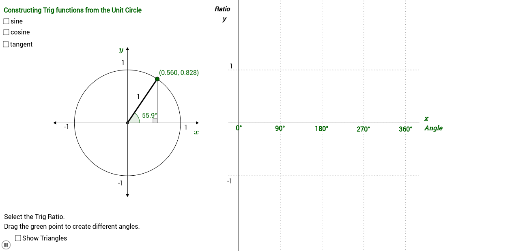
This example demonstrates the geometric interpretation of trigonometric ratios sinα, cosα, and tanα for any angle α on the unit circle. Key math concepts include the unit circle, definitions of trigonometric functions, side length ratios in right triangles, and angle-radius conversion. GeoGebra commands used in construction: Intersect, Function, Point, Circle, Tangent, Segment, OrthogonalLine, Angle, Ray. Suitable for high school students learning the relationship between trigonometric functions and the unit circle, or for teaching trigonometric limits in calculus.
GeoGebra Commands & Parameters
Intersect(xAxis, yAxis) → AFunction(0, 1.9, 5.5) → gPoint(g) → QPoint(yAxis) → BCircle(A, B) → cPoint(c) → DTangent(D, c) → e,Intersect(e, yAxis) → FIntersect(xAxis, e) → ESegment(F, E) → lSegment(E, A) → mIntersect(m, l) → OIntersect(c, xAxis, 2) → CSegment(A, C) → dOrthogonalLine(D, d) → fIntersect(f, m) → HSegment(A, H) → cosαAngle(Q, A, D) → αSegment(A, D) → bSegment(D, E) → tanαSegment(D, H) → sinαOrthogonalLine(D, sinα) → iFunction(sin((2 * (x - (2 * 3.14 / 3)))), 2.09, 5.24) → sineαIntersect(sineα, h, (2.612829828523947, 0.8618940213928555)) → IFunction(tan((2 * (x - (2 * 3.14 / 3)))), 2.09, 5.24) → tangentαIntersect(tangentα, h, (2.612829828523947, 1.6996916845347747)) → JFunction(cos((2 * (x - (2 * 3.14 / 3)))), 2.09, 5.24) → cosineαIntersect(cosineα, h, (2.612829828523947, 0.5070884497671505)) → KSegment(H, D) → jSegment(A, F) → kIntersect(j, m) → NIntersect(k, l) → PFunction(1, 1.9, 5.5) → pFunction(-1, 1.9, 5.5) → qPoint(c) → RSegment(C, R) → aSegment(A, H) → g_1Segment(D, H) → h_1Segment(A, E) → j_1Angle(A, D, E) → βRay(D, F) → i_1Ray(D, E) → l_1Intersect(c, a) → G, LOrthogonalLine(I, xAxis) → d_1Intersect(g, xAxis, 1) → MIntersect(g, xAxis, 1) → SIntersect(g, xAxis, 1) → TIntersect(g, d_1) → USegment(I, U) → e_1OrthogonalLine(K, xAxis) → k_1Intersect(k_1, xAxis) → VSegment(K, V) → m_1OrthogonalLine(J, xAxis) → n_1Intersect(n_1, xAxis) → WSegment(J, W) → p_1Point(yAxis) → ZPoint(yAxis) → A_1Segment(Z, A_1) → q_1Point(xAxis) → B_1Point(xAxis) → C_1Segment(B_1, C_1) → r_1OrthogonalLine(D, r_1) → c_1Intersect(g, r_1, 1) → D_1Intersect(c_1, r_1) → E_1Segment(D, E_1) → s_1Angle(D, E_1, A) → γ