
Unit Circle Definition of Inverse Trig Functions: arccos
Loading the math board and drawing, please wait…
In collections
Mapping Diagrams: From AB to C&DE, Resource
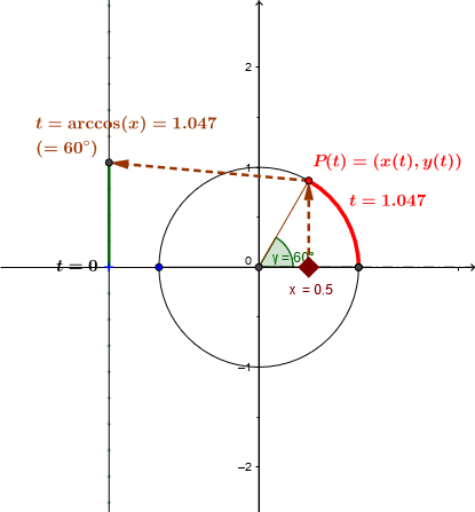
This GeoGebra example visualizes the definition of the inverse cosine function (arccos) on the unit circle, showing how the angle relates to the x-coordinate of a point on the circle. It demonstrates the geometric meaning of inverse trigonometric functions, emphasizing the relationship between angles, coordinates, and the principal value range. The construction uses commands such as Point, Circle, Intersect, Angle, Segment, OrthogonalLine, Sequence, Vector, Line, Ray, and CircleArc, along with objects like sliders and text labels to dynamically illustrate the concept. It is suitable for high school or introductory college students learning inverse trigonometry, and serves as an interactive teaching aid for understanding domain, range, and the graphical representation of arccos.
GeoGebra Commands & Parameters
Point(xAxis) → NPoint(yAxis) → DIntersect(xAxis, yAxis) → ACircle(A, B) → cSegment(A, C) → aSegment(B, A) → bAngle(B, A, C) → αOrthogonalLine(C, yAxis) → dSegment(D, A) → hSegment(H, B) → iSequence((-1.5, t), t, -87.96459430051421, 87.96459430051421, 0.2617993877991494) → tvalVector(C, K) → jVector(A, L) → kSegment(B, L) → lLine(L, B) → nSegment(T_0, t_2) → pRay(A, B) → qRay(A, C) → rCircleArc(A, B, C) → eVector(C, t_2) → w_2Vector(D, C) → u_3CircleArc(A, C, B) → sAngle(C, A, B) → βVector(F, E) → v_2OrthogonalLine(N, i) → c_1Intersect(e, c, 1) → OVector(N, O) → uIntersect(c, c_1, 2) → PVector(N, P) → vCircleArc(A, B, P) → d_1Vector(P, Q) → wAngle(B, A, P) → γRay(A, P) → e_1Point(f_1) → RSegment(R, A) → g_1Intersect(c, d_1) → S, , ,Intersect(c, g_1) → T,CircleArc(A, B, T) → h_1Vector(R, T) → u_1Angle(B, A, T) → δAngle(B, A, T) → εVector(T, U) → v_1Segment(A, P) → j_1Segment(T_0, Q) → k_1CircleArc(A, B, T) → p_1Vector(V, W) → w_1Vector(W, J) → zVector(W, M) → mSequence((0, k), k, -1, 1, 0.5) → list1Sequence((1, k), k, -1, 1, 0.5) → list2Sequence((2, k), k, -1, 1, 0.5) → list3