
Unit Circle and the Derivation of Sine, Cosine, and Tangent Functions
Loading the math board and drawing, please wait…
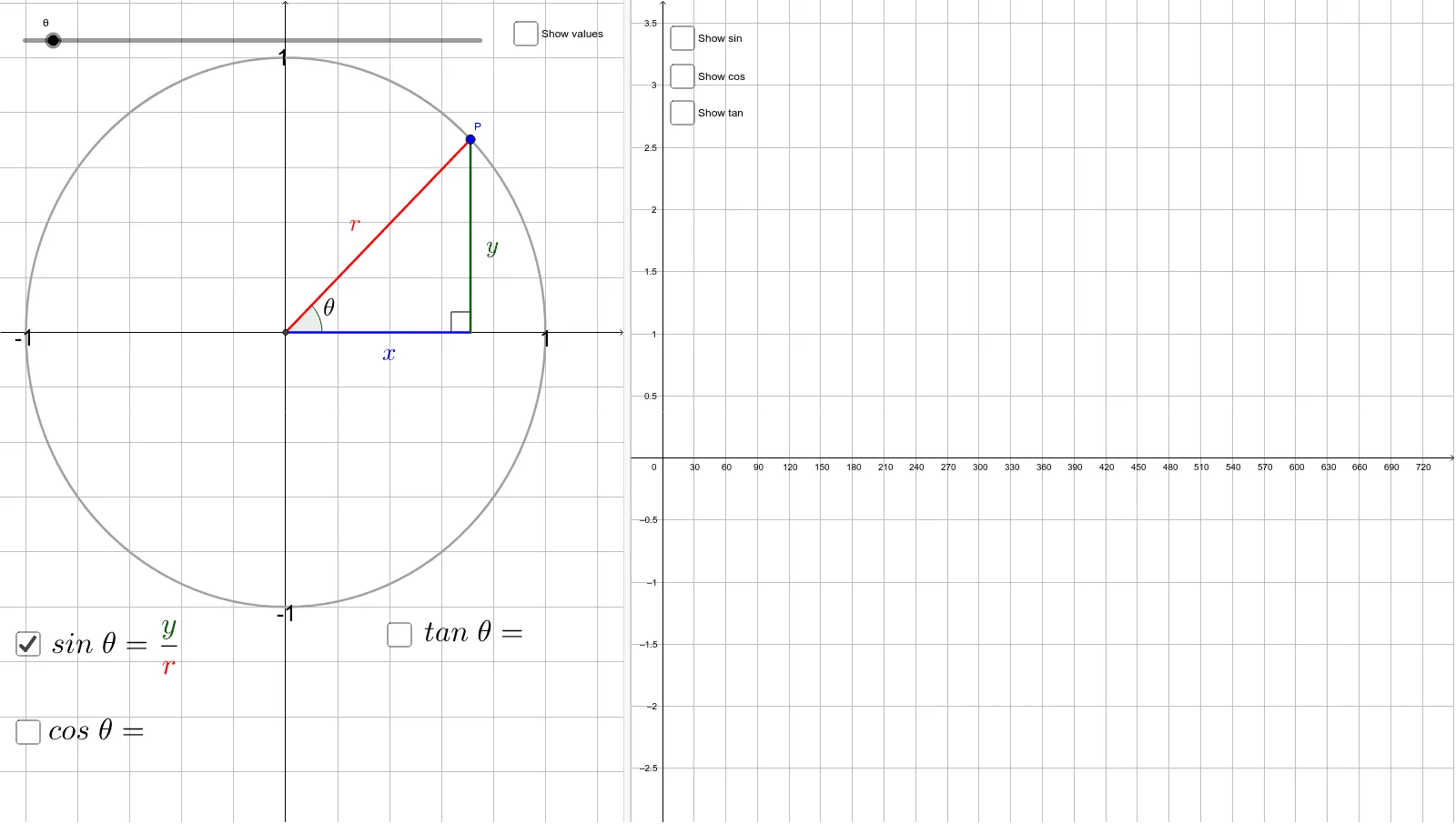
This GeoGebra example dynamically derives the sine, cosine, and tangent functions from the unit circle. It visually demonstrates that for an angle θ on the unit circle, the coordinates of point P give cosθ (x-coordinate) and sinθ (y-coordinate), while the tangent is represented by the length of a segment from the point (1,0) to the intersection with the angle's terminal side. The construction uses key GeoGebra commands: Circle to create the unit circle, Point and Intersect to define dynamic points, Rotate to animate the angle, Segment and Angle to form and label triangles, Distance to measure relevant lengths (AP, AD, DP), and text objects to display live values. This resource is ideal for high school or introductory college students learning trigonometric definitions, unit circle properties, and function graphing. It serves both as a classroom demonstration tool and for self-study, clarifying the periodic nature and geometric origins of trigonometric functions.
GeoGebra Commands & Parameters
Intersect(xAxis, yAxis) → APoint(yAxis) → BCircle(A, B) → cRotate(C, 0, A) → C'Rotate(C', θ°, A) → PSegment(P, A) → aSegment(A, D) → bSegment(D, P) → dAngle(P, D, A) → αAngle((1, 0), (0, 0), P) → βDistance(A, P) → distanceAPDistance(A, D) → distanceADDistance(D, P) → distanceDP