
Cosine Law Geometric Construction and Verification
Loading the math board and drawing, please wait…
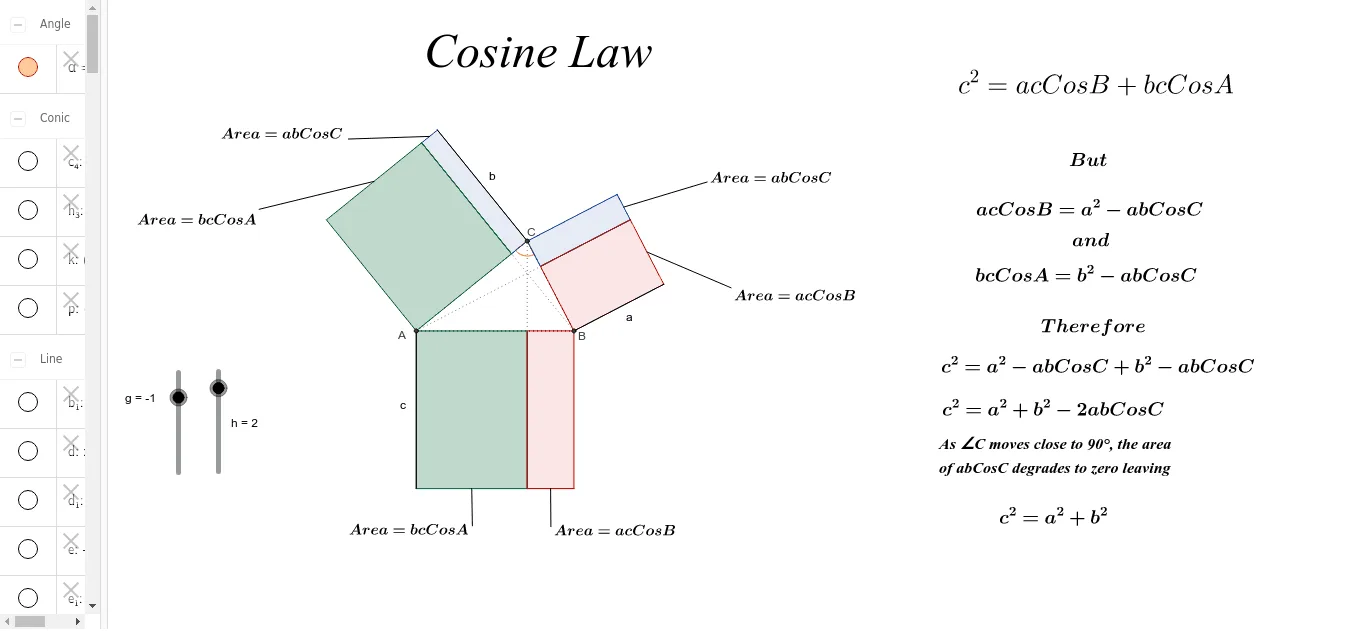
This example demonstrates the application of the cosine theorem in triangle geometry using GeoGebra. Key mathematical concepts include triangle side-angle relationships, the cosine theorem formula, and geometric construction techniques. Construction involves using commands like Circle, Intersect, and Polygon to create triangles and verify the theorem. Suitable for middle school students learning geometric proofs and high school students understanding trigonometric applications.
GeoGebra Commands & Parameters
Circle(A_1, 5) → c_4Intersect(c_4, b_1, 1) → AIntersect(c_4, b_1, 2) → BIntersect(c_4, d, 1) → CPolygon(A, C, B) → poly1, b_2, a_1, c_1Angle(A, C, B) → αOrthogonalLine(B, b_2) → eOrthogonalLine(C, c_1) → fOrthogonalLine(A, a_1) → g_3Intersect(e, b_2) → DIntersect(g_3, a_1) → EIntersect(f, c_1) → FCircle(F, c_1) → h_3Intersect(h_3, f, 2) → GSegment(F, G) → iCircle(D, b_2) → kIntersect(k, e, 2) → HSegment(D, H) → jCircle(E, a_1) → pIntersect(p, g_3, 2) → ISegment(E, I) → lLine(H, b_2) → mLine(G, c_1) → nLine(I, a_1) → qLine(C, j) → rLine(A, j) → sLine(A, i) → tLine(B, i) → d_1Line(B, l) → e_1Line(C, l) → f_1Intersect(m, r) → JIntersect(m, s) → KIntersect(q, f_1) → LIntersect(q, e_1) → MIntersect(n, t) → NIntersect(n, d_1) → OPolygon(D, H, J, C) → poly2, d_2, h_1, j_1, c_2Polygon(C, L, I, E) → poly3, c_3, l_1, i_1, e_2PointIn(poly2) → Pointpoly2PointIn(poly3) → Pointpoly3_1Polygon(A, K, H, D) → poly4, a_2, k_1, h_2, d_3Polygon(A, F, G, N) → poly5, a_3, f_2, g_1, n_1PointIn(poly5) → Pointpoly5PointIn(poly4) → Pointpoly4Polygon(F, B, O, G) → poly6, f_3, b_3, o, g_2Polygon(B, M, I, E) → poly7, a_5, m_1, i_2, e_3PointIn(poly7) → Pointpoly7PointIn(poly6) → Pointpoly6PointIn(poly3) → Pointpoly3Segment(B, D) → p_1Segment(A, E) → q_1Segment(F, C) → r_1Midpoint(h_1) → PMidpoint(k_1) → QMidpoint(g_1) → RMidpoint(o) → SMidpoint(l_1) → TMidpoint(m_1) → USegment(P, V) → s_1Segment(Q, W) → t_1Segment(R, Z) → j_2Segment(S, B_1) → k_2Segment(U, C_1) → l_2Segment(T, D_1) → m_2Segment(C, J) → bSegment(B, M) → aSegment(A, N) → c