
Unit Circle and Tangent Curve
Loading the math board and drawing, please wait…
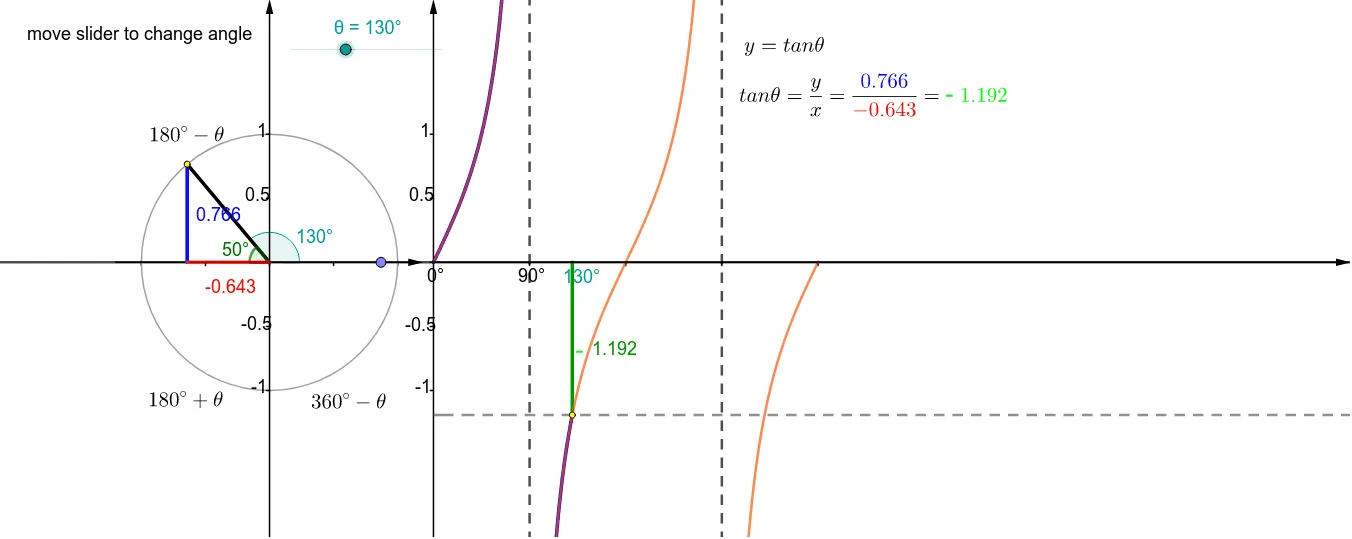
This example demonstrates the geometric relationship between the unit circle and the tangent curve. It involves core mathematical concepts such as the unit circle, tangent function, trigonometric functions, calculus, real numbers, and plane figures. The construction uses GeoGebra commands/objects like Point, Rotate, Segment, OrthogonalLine, Intersect, Angle, Circle, Vector, Sequence, and Midpoint. Suitable for high school and above students studying trigonometry, coordinate geometry, and calculus.
GeoGebra Commands & Parameters
Point(Ray[(0, 0), (-1, 0)]) → BRotate(A, θ, B) → PSegment(B, P) → aOrthogonalLine(P, a) → iIntersect(i, p) → FSegment(P, F) → jRotate(A, θ, B) → A'Angle(A, B, A') → αRotate(A, θ, B) → A'_1Angle(A, B, A'_1) → βSegment(Q, (x(Q), 0)) → eCircle(B, A) → cVector((x(B), y(Corner[1])), (x(B), y(Corner[4]))) → uVector((0, y(Corner[1])), (0, y(Corner[4]))) → wVector((0, 0), (x(Corner[2]), 0)) → zSequence(Segment[((0.75 * i), 0), ((0.75 * i), -0.025)], i, 1, 4) → list1Segment(P, (x(P), 0)) → bVector(B - (1.2, 0), B + (1.2, 0)) → vSequence(Segment[(0, (0.5 * i) - 1), (-0.025, (0.5 * i) - 1)], i, 0, 4) → list2Sequence(Segment[(x(B), (0.5 * i) - 1), (x(B) - 0.025, (0.5 * i) - 1)], i, 0, 4) → list3Sequence(Segment[B + ((0.5 * i) - 1, 0), B + ((0.5 * i) - 1, -0.025)], i, 0, 4) → list4Point(Ray[(0, 0), (-1, 0)]) → B_1Rotate(A_1, θ, B_1) → P_1Rotate(A_1, θ, B_1) → A'_2Rotate(A_1, θ, B_1) → A'_3Circle(B_1, A_1) → c_1Segment(B_1, P_1) → a_1Segment(B, (x(P), 0)) → hMidpoint(h) → CMidpoint(e) → DMidpoint(b) → EOrthogonalLine(Q, w) → kOrthogonalLine(Q, w) → lPoint(p) → GAngle(P, B, G) → δPoint(p) → HAngle(G, B, P) → εPoint(p) → IAngle(P, B, I) → ζ
AI Drawing Prompt Reference
Draw a unit circle with its center on the negative x-axis. A point on the circle rotates by an angle, and a radius segment connects the center to this point. Through the point, draw a line perpendicular to the radius, intersecting a horizontal reference line at a point. Connect this intersection back to the rotating point with a segment, and label the rotation angle. Below the circle, place a horizontal number line with tick markscars. Drop a perpendicular from the rotating point to the number line to represent the tangent value. Additionally, below this, construct a second similar circle and tangent structure with auxiliary segments and angle labels, illustrating the geometric link between the unit circle and the tangent curve.
The prompt above was compiled from the original drawing commands and is for reference only.