
Unit Circle and Inverse Trig Graphs
Loading the math board and drawing, please wait…
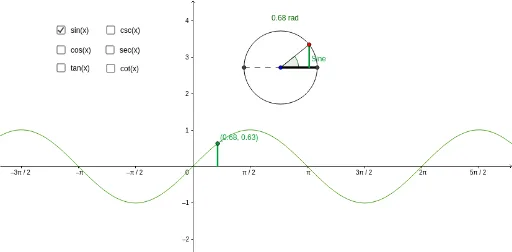
This example demonstrates the relationship between the unit circle and graphs of sine, cosine, tangent, and inverse trigonometric functions. It involves core math concepts like the unit circle definition, trigonometric functions, inverse trigonometric functions, derivatives, and analytical geometry. Construction uses GeoGebra commands such as Line, Point, Segment, Intersect, Circle, Angle, and OrthogonalLine. Suitable for high school and above mathematics learning to understand trigonometric properties and graph transformations.
GeoGebra Commands & Parameters
Line(A, xAxis) → aPoint(a) → B_1Segment(A, B_1) → bIntersect(xAxis, yAxis) → DCircle(A, b) → cPoint(c) → CSegment(A, C) → dAngle(B_1, A, C) → αPoint(Circle[D, α]) → ESegment(D, E) → eOrthogonalLine(C, b) → h_1Intersect(h_1, a) → FSegment(C, F) → SineIntersect(c, a, 2) → GSegment(G, A) → iSegment(A, F) → CosineOrthogonalLine(C, d) → jIntersect(a, j) → HSegment(C, H) → TangentSegment(B_1, H) → k_1OrthogonalLine(E, xAxis) → lIntersect(g, l, (0.6775728175269462, 0.782731011348612)) → IIntersect(f, l, (0.6775728175269462, 0.6298282915862481)) → JIntersect(n, l, (0.6775728175269462, 0.8084084484644634)) → KSegment(J, E) → qSegment(I, E) → rSegment(K, E) → pIntersect(f_1, l, (0.6775728175269462, 1.6025820473500487)) → LIntersect(g_1, l, (0.6775728175269462, 1.289525390427809)) → MIntersect(n_1, l, (0.6775728175269462, 1.2485662599475453)) → NOrthogonalLine(C, d) → a_1OrthogonalLine(A, i) → b_1Intersect(a_1, b_1) → OSegment(O, C) → CotangentOrthogonalLine(N, xAxis) → c_1Intersect(c_1, xAxis) → PSegment(N, P) → d_1Line(A, B_1) → sOrthogonalLine(C, d) → e_1Intersect(s, e_1) → QSegment(C, Q) → i_1Segment(A, Q) → SecantOrthogonalLine(M, xAxis) → j_1Intersect(j_1, xAxis) → RSegment(M, R) → l_1OrthogonalLine(A, i) → m_1OrthogonalLine(C, d) → p_1Intersect(m_1, p_1) → SSegment(S, A) → CosecantOrthogonalLine(L, xAxis) → q_1Intersect(q_1, xAxis) → TSegment(L, T) → r_1Intersect(c, b, 1) → U
AI Drawing Prompt Reference
Draw the unit circle and its relationship with sine, cosine, tangent, and inverse trigonometric functions. Start by drawing the x-axis and the unit circle, then use points on the unit circle to draw sine, cosine, and tangent segments. Next, sketch the graphs of inverse trigonometric functions, and finally connect key points to form the unit circle and inverse trigonometric function graphs.
The prompt above was compiled from the original drawing commands and is for reference only.