
Unit Circle and Cosine Graph by Mario
Loading the math board and drawing, please wait…
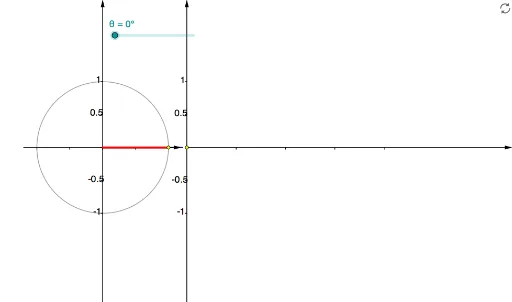
This example demonstrates generating a cosine graph from the unit circle. It shows the relationship between the rotation of a point on the unit circle and the cosine value. Key mathematical concepts include the unit circle and cosine function. GeoGebra commands used include Point, Rotate, Angle, Circle, Segment, Vector, Sequence, etc. Suitable for high school mathematics education and learning.
GeoGebra Commands & Parameters
Point(Ray[(0, 0), (-1, 0)]) → BRotate(A, θ, B) → PRotate(A, θ, B) → A'Angle(A, B, A') → αRotate(A, θ, B) → A'_1Angle(A, B, A'_1) → βCircle(B, A) → cSegment(B, P) → aVector((x(B), y(Corner[1])), (x(B), y(Corner[4]))) → uVector((0, y(Corner[1])), (0, y(Corner[4]))) → wVector((0, 0), (x(Corner[2]), 0)) → zSequence(Segment[((0.75 * i), 0), ((0.75 * i), -0.025)], i, 1, 4) → list1Vector(B - (1.2, 0), B + (1.2, 0)) → vSequence(Segment[(0, (0.5 * i) - 1), (-0.025, (0.5 * i) - 1)], i, 0, 4) → list2Sequence(Segment[(x(B), (0.5 * i) - 1), (x(B) - 0.025, (0.5 * i) - 1)], i, 0, 4) → list3Segment(P, Q) → dSequence(Segment[B + ((0.5 * i) - 1, 0), B + ((0.5 * i) - 1, -0.025)], i, 0, 4) → list4Point(Ray[(0, 0), (-1, 0)]) → B_1Rotate(A_1, θ, B_1) → P_1Rotate(A_1, θ, B_1) → A'_2Rotate(A_1, θ, B_1) → A'_3Circle(B_1, A_1) → c_1Segment(B_1, P_1) → a_1Segment(P, (-1.279, y(P))) → bSegment(Q, Point[Circle[Q, 0]]) → e
AI Drawing Prompt Reference
Draw a unit circle and plot the cosine graph by rotating a point P on the circle. Start by drawing a point B to the left of the origin, then rotate point A around B to get P and record the angle α. Draw the unit circle c, connect B and P with segment a, and draw the parallel lines u and w to the x-axis and y-axis. Then draw 4 vertical segments from the origin to represent the radius of the unit circle. Next, draw a horizontal line v from B and 4 vertical segments from the origin to represent the cosine values. Finally, draw a perpendicular line b from P to the x-axis and a tangent line e from P to the unit circle.
The prompt above was compiled from the original drawing commands and is for reference only.