
Unified Construction of Conic Sections
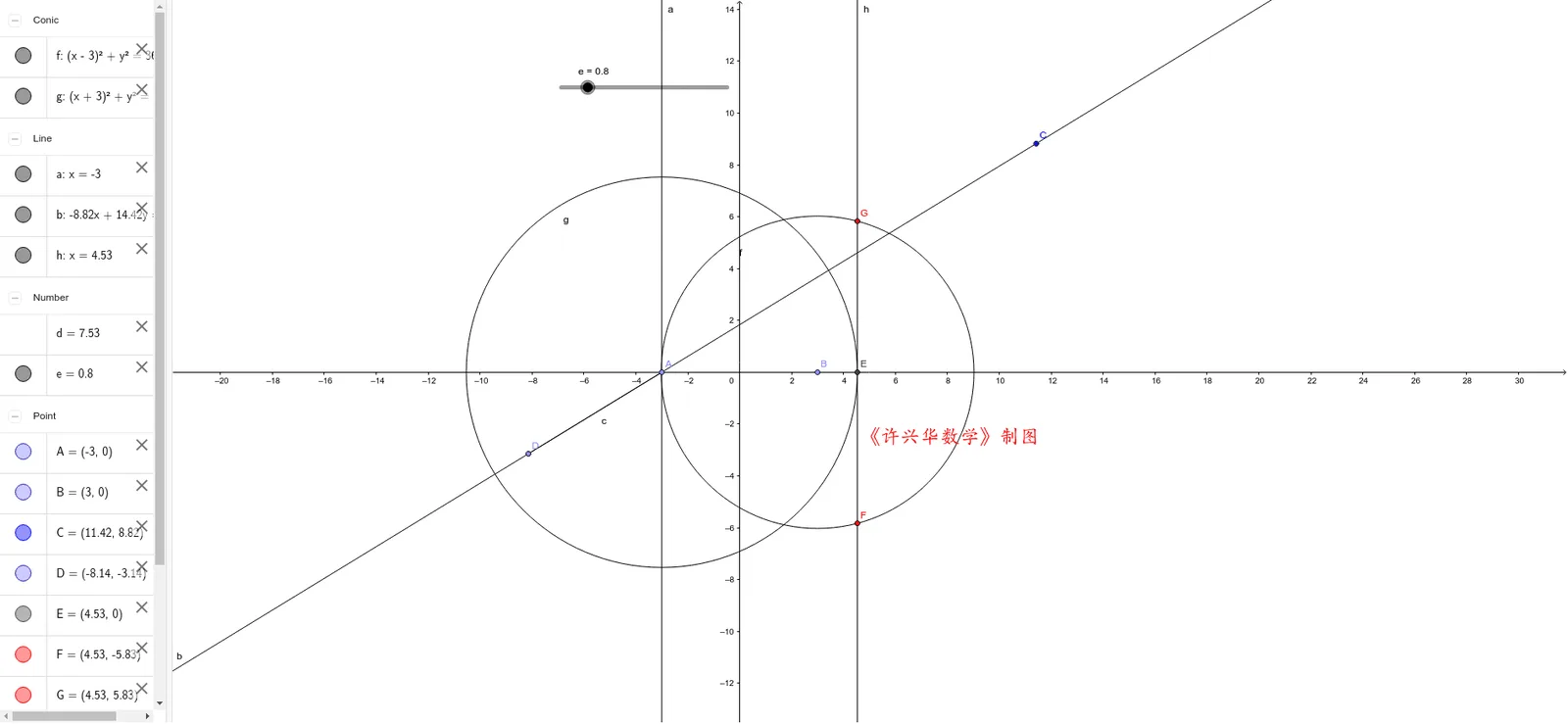
This GeoGebra example demonstrates a unified geometric construction method for conic sections, including ellipses, parabolas, and hyperbolas. Using fundamental geometric elements such as points, orthogonal lines, line segments, circles, and their intersections, the construction illustrates how different types of conic sections can be generated through a common geometric approach. Based on the focus-directrix relationship and the properties of planar cross-sections of cones, this applet helps learners intuitively understand the intrinsic connections and geometric unity among ellipses, parabolas, and hyperbolas. Users can interactively manipulate key parameters such as the position of the focus, the location of the directrix, and the eccentricity value to observe how these elements determine which type of conic section is produced. When the eccentricity is less than one, an ellipse is formed; when it equals one, a parabola results; and when it exceeds one, a hyperbola emerges. This dynamic exploration reinforces the single defining property shared by all conic sections: the locus of points whose distance to a fixed point (the focus) bears a constant ratio to their distance to a fixed line (the directrix). The applet serves as an essential visualization tool in analytic geometry and geometric construction instruction, bridging the gap between algebraic definitions and geometric intuition. Students benefit by developing a deeper conceptual understanding of why these three curves are fundamentally related, rather than treating them as isolated topics. The interactive nature of the construction encourages exploration and discovery, allowing learners to test hypotheses and observe immediate visual feedback as they adjust parameters.
Loading the math board and drawing, please wait…