
Conic Sections Paper Folding Activity (Textbook Example)
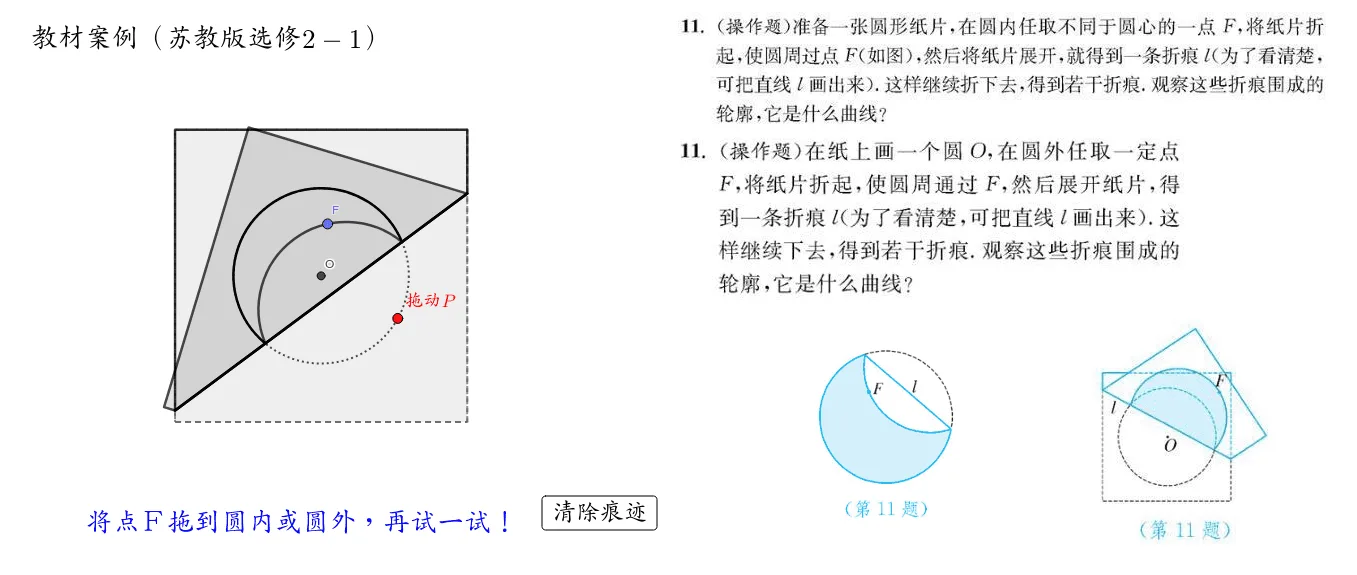
This GeoGebra applet demonstrates the geometric properties of conic sections, specifically ellipses and hyperbolas, through interactive paper folding operations. Using commands such as LineBisector, Intersect, and Sequence, the applet simulates the process by which fold lines in a piece of paper gradually form the envelope of a conic curve. The construction combines polygons, circles, and mirror symmetry to recreate the physical act of folding a point onto a given circle or line, producing fold lines that are precisely the perpendicular bisectors involved in the definition of each conic section.
For the ellipse, a point is folded onto a fixed interior point (focus) while the paper edge forms a circle; the resulting fold lines envelope an ellipse with the fixed point and the circle's center serving as the two foci. For the hyperbola, a similar folding process is applied with the fixed point positioned outside the circle, causing the fold lines to envelope a hyperbola instead. The applet allows students to dynamically adjust the positions of key elements and observe in real time how the轨迹 of fold lines converges to reveal the characteristic shape of each conic section.
This classic textbook example visually illustrates the relationship between special points, trajectories, and the defining properties of conic sections, bridging analytic geometry and geometric construction in a single interactive model. By manipulating the parameters and watching the envelope emerge, students gain an intuitive understanding of why conic sections are defined the way they are and how their geometric properties arise naturally from simple folding operations. The activity is particularly valuable for deepening students conceptual grasp of conic definitions, the role of foci and directrices, and the connection between algebraic descriptions and visual geometry.
Loading the math board and drawing, please wait…