
Conic Sections Paper Folding Exploration (Textbook Case)
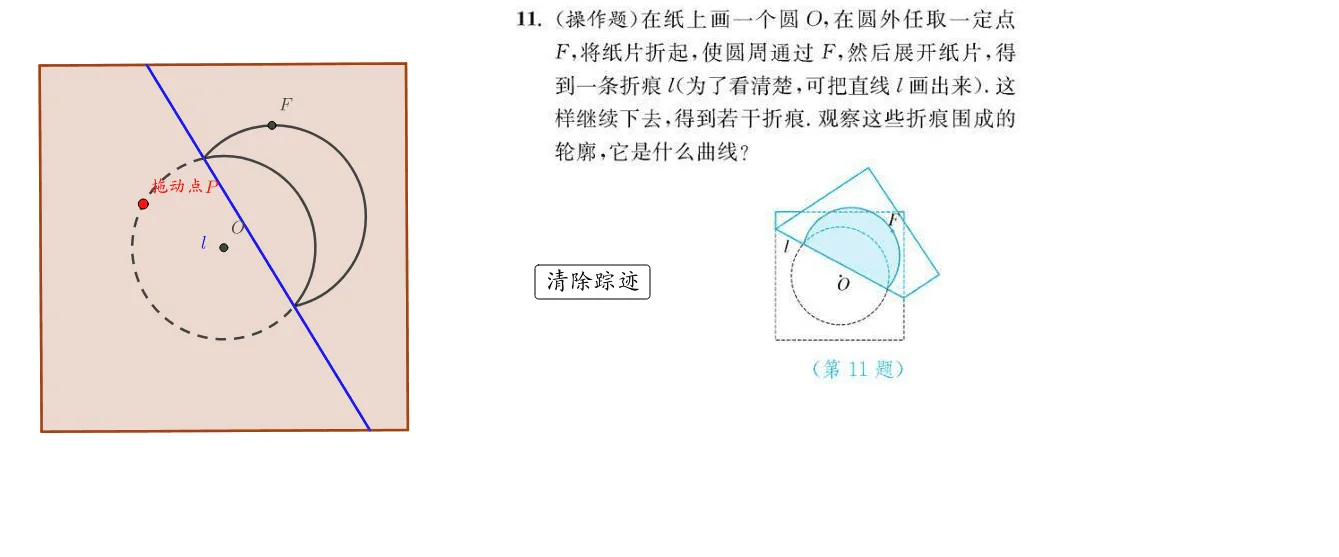
This GeoGebra applet demonstrates the generation principles of conic sections through paper folding operations. Using geometric construction commands including polygon, midpoint, circle, intersection, segment, circumcircle arc, mirror reflection, and circular arc, it simulates the geometric relationships between key points and fold lines during the paper folding process. Through interactive dragging of point P and other controls, students can observe how the envelope of fold lines forms ellipses, parabolas, or hyperbolas depending on the relative positions of the focus and directrix. This case study combines hands-on paper folding with analytic geometry, providing an intuitive visualization of core conic section concepts such as foci and directrices. The applet is suitable for teaching demonstrations and exploratory activities in the conic sections chapter of high school mathematics textbooks. Students can manipulate parameters in real time to see how changing the distance between a fixed point (focus) and a fixed line (directrix) determines the type of conic section generated. This interactive approach helps learners develop a deeper geometric intuition for why conic sections arise from the fold-and-trace construction, bridging the gap between classical synthetic geometry and coordinate-based algebraic definitions. The step-by-step visual construction also reinforces the locus definition of conics as sets of points satisfying specific distance relationships, making it an effective pedagogical tool for both classroom instruction and independent exploration.
Loading the math board and drawing, please wait…