
Second Definition of an Ellipse and Locus Demonstration
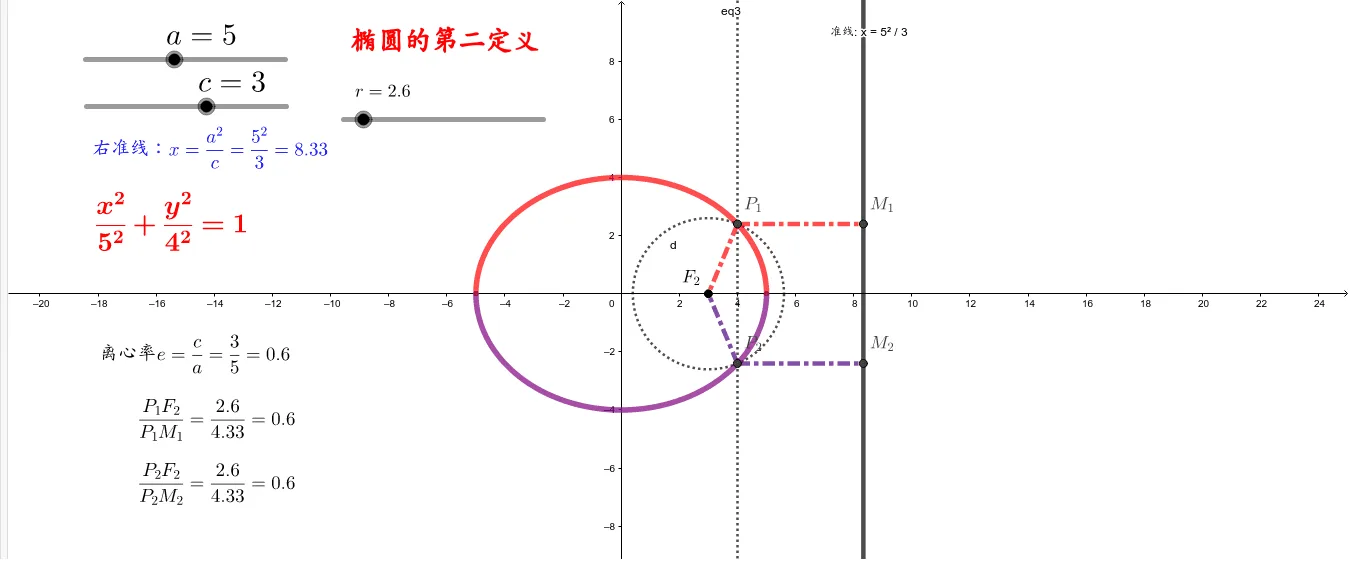
This GeoGebra applet dynamically demonstrates the second definition of an ellipse, also known as the focus-directrix definition. By constructing the focus, directrix, and the distance ratio, it uses the Locus command to generate the elliptic curve. The applet visually illustrates the geometric process where the locus forms an ellipse when the ratio of distances from a moving point to a fixed point and to a fixed line is a constant less than one. Learners can interact with the construction by dragging the moving point or adjusting parameters such as the eccentricity, observing in real time how the shape changes as the ratio varies. When the ratio is smaller, the ellipse becomes more circular; as the ratio approaches one, the curve flattens, approaching the boundary between an ellipse and a parabola. This interactive exploration helps students build an intuitive understanding of how eccentricity governs the shape of conic sections. The applet reinforces the unified definition of conics, showing that ellipses, parabolas, and hyperbolas can all be characterized by the same distance-ratio principle, with eccentricity serving as the distinguishing parameter. Students benefit from immediate visual feedback, which connects abstract algebraic concepts to concrete geometric behavior and supports deeper conceptual retention beyond rote memorization.
In collections
Vocational High School Mathematics
Loading the math board and drawing, please wait…