
Undulary Surface: A Logarithmic Function‑Generated Surface of Revolution
Loading the math board and drawing, please wait…
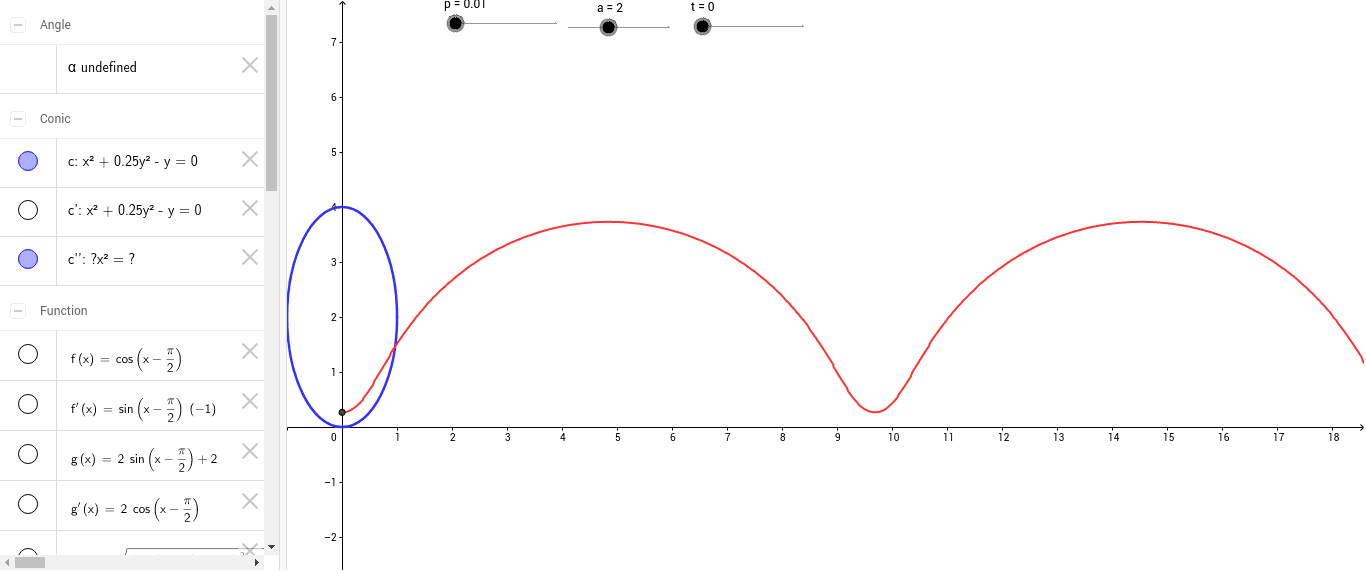
① This example demonstrates the Undulary surface, a surface of revolution created by rotating a curve derived from a logarithmic function (or its derivative) around an axis. ② The core mathematics involves logarithmic functions, derivatives, solving ordinary differential equations, parametric equations, and the geometry of surfaces and loci. ③ The construction uses GeoGebra commands such as Focus, Derivative, SolveODE, First, Element, Vector, Translate, Angle, Rotate, and Locus, together with a set of auxiliary objects to build the surface step by step. ④ It is intended for high‑school or undergraduate students studying geometry, calculus, or mathematical modeling.
GeoGebra Commands & Parameters
Focus(c) → A, BDerivative(f, x) → f'SolveODE(l, 0, 0, 18.84956, p) → loc1Derivative(g, x) → g'First(loc1, Length[loc1]) → list1Element(list1, t / p + 1) → LVector(E, D) → uTranslate(c, u) → c'Angle(D, G, F) → αRotate(c', -α, D) → c''Translate(A, u) → A'Rotate(A', -α, D) → A''Locus(A'', t) → loc2