
Understanding the Role of a, b, and r in the Circle Equation (x‑a)² + (y‑b)² = r
Loading the math board and drawing, please wait…
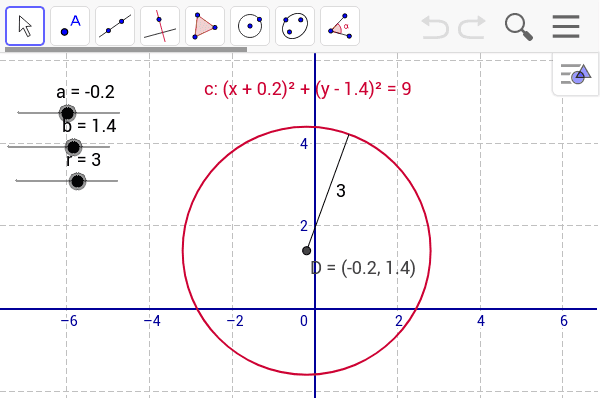
This example illustrates how the parameters a, b, and r determine the position and size of a circle given by the equation (x‑a)² + (y‑b)² = r². It demonstrates the concept of coordinate geometry, specifically the standard form of a circle's equation, and shows how the center (a,b) and radius r affect the graph. Using GeoGebra, the construction employs objects a, b, r as sliders, creates the circle c, draws tangents, orthogonal lines, intersections, and segments to visualize geometric relationships. The activity is suitable for middle‑school and high‑school students learning analytic geometry and for teachers preparing interactive lessons.
GeoGebra Commands & Parameters
Point(c) → ATangent(A, c) → d,OrthogonalLine(A, d) → ePoint(c) → BTangent(B, c) → f,OrthogonalLine(B, f) → gIntersect(e, g) → CPoint(c) → ESegment(D, E) → h
AI Drawing Prompt Reference
Draw a circle with center at (a, b) and radius r. Use sliders to adjust a, b, and r and observe changes in the circle's position and size. Draw two tangents to the circle and their respective perpendicular lines. Find the intersection of these perpendicular lines and draw a segment on the circle.
The prompt above was compiled from the original drawing commands and is for reference only.