
Types of Angles
Loading the math board and drawing, please wait…
In collections
Wiederholung Winkel: Bezeichnung, Arten, Messen & Zeichnen
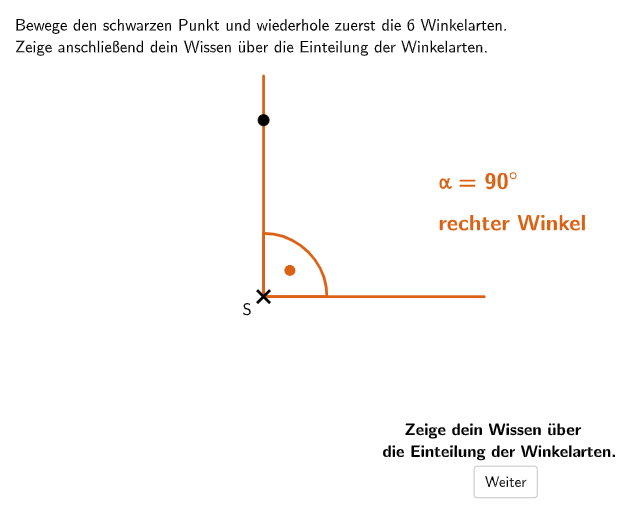
This example demonstrates different types of angles, including right angles, acute angles, obtuse angles, straight angles, and full angles. It involves basic angle concepts such as angle measurement and classification. Using GeoGebra commands like Point, Sequence, Polygon, etc., it dynamically shows the changes in angles. Suitable for middle and high school students learning geometry.
GeoGebra Commands & Parameters
Point(yAxis) → CPoint(yAxis) → ASequence(Rotate[C, m°, A], m, 1, 360) → listcirclePolygon(allowedRect4, allowedRect3, allowedRect2, allowedRect1) → allowedRect, a_1, b, c, dMax(widthsOptionsR) → widthRMax(heightsOptionsR) → heightRMax(heightR, Max[heightsOptionsL]) → heightLMax(widthsOptionsL) → widthLIf(isShuffleOptionsLechts, Shuffle[1…numOptionsR], 1…numOptionsR) → indizesOptionsRechtsIf(isShuffleOptionsLinks, Shuffle[1…numOptionsL], 1…numOptionsL) → indizesOptionsLinksTextfield(input1) → InputBox1Textfield(input2) → InputBox2Polygon(PtopLeftCornerFeedback, PtopRightCornerFeedback, PbottomRightCornerFeedback, PbottomLeftCornerFeedback) → rectangleCorrect, rectangleCorrectS3, rectangleCorrectS4, rectangleCorrectS2, rectangleCorrectS1Shuffle(Sequence[Random[0, 10], i, 1, 100]) → randomNosForX, {7, 5, 2, 7, 0, 10, 3, 9, 2, 8, 8, 5, 5, 4, 7, 2, 5, 6, 5, 8, 2, 2, 1, 8, 8, 1, 9, 4, 3, 7, 2, 6, 7, 5, 7, 4, 6, 4, 6, 4, 5, 2, 1, 0, 3, 9, 9, 2, 6, 3, 3, 5, 6, 1, 8, 8, 4, 8, 9, 0, 7, 0, 7, 10, 10, 3, 4, 6, 0, 1, 3, 0, 1, 8, 4, 4, 10, 8, 2, 6, 1, 4, 10, 1, 1, 3, 1, 4, 10, 8, 0, 6, 2, 2, 7, 7, 7, 0, 0, 7}Element(randomNosForX, Mod[questionCount, 100] + 1) → numXShuffle(Sequence[Random[0, 10], i, 1, 100]) → randomNosForY, {8, 3, 3, 7, 0, 8, 4, 2, 10, 5, 4, 2, 4, 1, 7, 9, 6, 0, 6, 5, 7, 6, 3, 8, 6, 0, 8, 7, 1, 3, 4, 5, 8, 9, 8, 1, 4, 4, 6, 6, 0, 9, 7, 6, 0, 1, 2, 4, 10, 9, 4, 9, 3, 10, 9, 1, 7, 1, 9, 3, 8, 6, 2, 8, 6, 0, 1, 9, 6, 1, 8, 2, 7, 9, 0, 8, 2, 3, 0, 3, 8, 0, 0, 8, 4, 2, 1, 9, 2, 3, 7, 4, 7, 3, 4, 0, 4, 7, 2, 2}Element(randomNosForY, Mod[questionCount, 100] + 1) → numYAppend(true, Sequence[If[randomNosForX(i) ≟ randomNosForX(i - 1), false, true], i, 2, 100]) → stayXAppend(true, Sequence[If[randomNosForY(i) ≟ randomNosForY(i - 1), false, true], i, 2, 100]) → stayYRemove(Sequence[If[stayX(i), randomNosForX(i), 0], i, 1, 100], Sequence[0, i, 1, 100]) → randomNosForXwithoutRepeatRemove(Sequence[If[stayY(i), randomNosForY(i), 0], i, 1, 100], Sequence[0, i, 1, 100]) → randomNosForYwithoutRepeatElement(randomNosForXwithoutRepeat, Mod[questionCount, Length[randomNosForXwithoutRepeat]] + 1) → numXwithoutRepeatElement(randomNosForYwithoutRepeat, Mod[questionCount, Length[randomNosForYwithoutRepeat]] + 1) → numYwithoutRepeatSequence(1) → positionsOptionsRechtsSequence(Element[optionsRAll, indizesOptionsRechts(i)], i, 1, numOptionsR) → optionsRActualLength(optionsRActual) → aSequence(Element[optionsLAll, indizesOptionsLinks(i)], i, 1, numOptionsL) → optionsLActualSequence(allOptionsL(indizesOptionsLinks(i)), i, 1, numOptionsL) → optionsLSequence(allOptionsR(indizesOptionsLinks(i)), i, 1, numOptionsL) → optionsRText(optionsLActual(6), CenterOptionL6, true, true, 0, 0) → opL6Text(optionsLActual(7), CenterOptionL7, true, true, 0, 0) → opL7Circle(A, C) → c_2Point(listcircle) → DRay(A, D) → h_2Point(h_2) → FSegment(A, F) → i_2Segment(A, E) → j_2Angle(B, A, D) → αCircle(A, 1.43) → d_2IndexOf(D, listcircle) → oText(optionsLActual(1), CenterOptionL1, true, true, 0, 0) → opL1Text(optionsLActual(2), CenterOptionL2, true, true, 0, 0) → opL2Text(optionsLActual(3), CenterOptionL3, true, true, 0, 0) → opL3Text(optionsLActual(4), CenterOptionL4, true, true, 0, 0) → opL4Text(optionsLActual(5), CenterOptionL5, true, true, 0, 0) → opL5PointIn(allowedRect) → CenterOptionR1Text(optionsRActual(1), CenterOptionR1, true, true, 0, 0) → opR1Polygon(CenterOptionR1, CenterOptionR1 - (widthR / 2, heightR / 2), CenterOptionR1 + (widthR / 2, ((-heightR)) / 2), CenterOptionR1 + (widthR / 2, heightR / 2), CenterOptionR1 - (widthR / 2, ((-heightR)) / 2), CenterOptionR1 - (widthR / 2, heightR / 2)) → rectRMove1, centeroptionr1, f, g, h, i, jPointIn(allowedRect) → CenterOptionR2Text(optionsRActual(2), CenterOptionR2, true, true, 0, 0) → opR2Polygon(CenterOptionR2, CenterOptionR2 - (widthR / 2, heightR / 2), CenterOptionR2 + (widthR / 2, ((-heightR)) / 2), CenterOptionR2 + (widthR / 2, heightR / 2), CenterOptionR2 - (widthR / 2, ((-heightR)) / 2), CenterOptionR2 - (widthR / 2, heightR / 2)) → rectRMove2, centeroptionr2, k, l, m, n, pPointIn(allowedRect) → CenterOptionR3Text(optionsRActual(3), CenterOptionR3, true, true, 0, 0) → opR3Polygon(CenterOptionR3, CenterOptionR3 - (widthR / 2, heightR / 2), CenterOptionR3 + (widthR / 2, ((-heightR)) / 2), CenterOptionR3 + (widthR / 2, heightR / 2), CenterOptionR3 - (widthR / 2, ((-heightR)) / 2), CenterOptionR3 - (widthR / 2, heightR / 2)) → rectRMove3, centeroptionr3, q, r, s, t, ePointIn(allowedRect) → CenterOptionR4Text(optionsRActual(4), CenterOptionR4, true, true, 0, 0) → opR4Polygon(CenterOptionR4, CenterOptionR4 - (widthR / 2, heightR / 2), CenterOptionR4 + (widthR / 2, ((-heightR)) / 2), CenterOptionR4 + (widthR / 2, heightR / 2), CenterOptionR4 - (widthR / 2, ((-heightR)) / 2), CenterOptionR4 - (widthR / 2, heightR / 2)) → rectRMove4, centeroptionr4, f_1, g_1, h_1, i_1, j_1PointIn(allowedRect) → CenterOptionR5Text(optionsRActual(5), CenterOptionR5, true, true, 0, 0) → opR5Polygon(CenterOptionR5, CenterOptionR5 - (widthR / 2, heightR / 2), CenterOptionR5 + (widthR / 2, ((-heightR)) / 2), CenterOptionR5 + (widthR / 2, heightR / 2), CenterOptionR5 - (widthR / 2, ((-heightR)) / 2), CenterOptionR5 - (widthR / 2, heightR / 2)) → rectRMove5, centeroptionr5, k_1, l_1, m_1, n_1, p_1PointIn(allowedRect) → CenterOptionR6Text(optionsRActual(6), CenterOptionR6, true, true, 0, 0) → opR6Polygon(CenterOptionR6, CenterOptionR6 - (widthR / 2, heightR / 2), CenterOptionR6 + (widthR / 2, ((-heightR)) / 2), CenterOptionR6 + (widthR / 2, heightR / 2), CenterOptionR6 - (widthR / 2, ((-heightR)) / 2), CenterOptionR6 - (widthR / 2, heightR / 2)) → rectRMove6, centeroptionr6, q_1, r_1, s_1, t_1, b_1PointIn(allowedRect) → CenterOptionR7Text(optionsRActual(7), CenterOptionR7, true, true, 0, 0) → opR7Polygon(CenterOptionR7, CenterOptionR7 - (widthR / 2, heightR / 2), CenterOptionR7 + (widthR / 2, ((-heightR)) / 2), CenterOptionR7 + (widthR / 2, heightR / 2), CenterOptionR7 - (widthR / 2, ((-heightR)) / 2), CenterOptionR7 - (widthR / 2, heightR / 2)) → rectRMove7, centeroptionr7, c_1, d_1, e_1, f_2, g_2If(CountIf[P ∈ answerRectLarger1(1), P, verticesR1] ≟ 4, 1, CountIf[P ∈ answerRectLarger6(1), P, verticesR1] ≟ 4, 6, CountIf[P ∈ answerRectLarger7(1), P, verticesR1] ≟ 4, 7, -1, CountIf[P ∈ answerRectLarger2(1), P, verticesR1] ≟ 4, 2, CountIf[P ∈ answerRectLarger3(1), P, verticesR1] ≟ 4, 3, CountIf[P ∈ answerRectLarger4(1), P, verticesR1] ≟ 4, 4, CountIf[P ∈ answerRectLarger5(1), P, verticesR1] ≟ 4, 5) → indexAnswerR1If(CountIf[P ∈ answerRectLarger1(1), P, verticesR2] ≟ 4, 1, CountIf[P ∈ answerRectLarger6(1), P, verticesR2] ≟ 4, 6, CountIf[P ∈ answerRectLarger7(1), P, verticesR2] ≟ 4, 7, -1, CountIf[P ∈ answerRectLarger2(1), P, verticesR2] ≟ 4, 2, CountIf[P ∈ answerRectLarger3(1), P, verticesR2] ≟ 4, 3, CountIf[P ∈ answerRectLarger4(1), P, verticesR2] ≟ 4, 4, CountIf[P ∈ answerRectLarger5(1), P, verticesR2] ≟ 4, 5) → indexAnswerR2If(CountIf[P ∈ answerRectLarger1(1), P, verticesR3] ≟ 4, 1, CountIf[P ∈ answerRectLarger6(1), P, verticesR3] ≟ 4, 6, CountIf[P ∈ answerRectLarger7(1), P, verticesR3] ≟ 4, 7, -1, CountIf[P ∈ answerRectLarger2(1), P, verticesR3] ≟ 4, 2, CountIf[P ∈ answerRectLarger3(1), P, verticesR3] ≟ 4, 3, CountIf[P ∈ answerRectLarger4(1), P, verticesR3] ≟ 4, 4, CountIf[P ∈ answerRectLarger5(1), P, verticesR3] ≟ 4, 5) → indexAnswerR3If(CountIf[P ∈ answerRectLarger1(1), P, verticesR4] ≟ 4, 1, CountIf[P ∈ answerRectLarger6(1), P, verticesR4] ≟ 4, 6, CountIf[P ∈ answerRectLarger7(1), P, verticesR4] ≟ 4, 7, -1, CountIf[P ∈ answerRectLarger2(1), P, verticesR4] ≟ 4, 2, CountIf[P ∈ answerRectLarger3(1), P, verticesR4] ≟ 4, 3, CountIf[P ∈ answerRectLarger4(1), P, verticesR4] ≟ 4, 4, CountIf[P ∈ answerRectLarger5(1), P, verticesR4] ≟ 4, 5) → indexAnswerR4If(CountIf[P ∈ answerRectLarger1(1), P, verticesR5] ≟ 4, 1, CountIf[P ∈ answerRectLarger6(1), P, verticesR5] ≟ 4, 6, CountIf[P ∈ answerRectLarger7(1), P, verticesR5] ≟ 4, 7, -1, CountIf[P ∈ answerRectLarger2(1), P, verticesR5] ≟ 4, 2, CountIf[P ∈ answerRectLarger3(1), P, verticesR5] ≟ 4, 3, CountIf[P ∈ answerRectLarger4(1), P, verticesR5] ≟ 4, 4, CountIf[P ∈ answerRectLarger5(1), P, verticesR5] ≟ 4, 5) → indexAnswerR5If(CountIf[P ∈ answerRectLarger1(1), P, verticesR6] ≟ 4, 1, CountIf[P ∈ answerRectLarger6(1), P, verticesR6] ≟ 4, 6, CountIf[P ∈ answerRectLarger7(1), P, verticesR6] ≟ 4, 7, -1, CountIf[P ∈ answerRectLarger2(1), P, verticesR6] ≟ 4, 2, CountIf[P ∈ answerRectLarger3(1), P, verticesR6] ≟ 4, 3, CountIf[P ∈ answerRectLarger4(1), P, verticesR6] ≟ 4, 4, CountIf[P ∈ answerRectLarger5(1), P, verticesR6] ≟ 4, 5) → indexAnswerR6If(CountIf[P ∈ answerRectLarger1(1), P, verticesR7] ≟ 4, 1, CountIf[P ∈ answerRectLarger6(1), P, verticesR7] ≟ 4, 6, CountIf[P ∈ answerRectLarger7(1), P, verticesR7] ≟ 4, 7, -1, CountIf[P ∈ answerRectLarger2(1), P, verticesR7] ≟ 4, 2, CountIf[P ∈ answerRectLarger3(1), P, verticesR7] ≟ 4, 3, CountIf[P ∈ answerRectLarger4(1), P, verticesR7] ≟ 4, 4, CountIf[P ∈ answerRectLarger5(1), P, verticesR7] ≟ 4, 5) → indexAnswerR7CountIf(ind ≠ -1, ind, indizesAnswerR) → numAnswersDraggedToLeftIf(correct, "\vphantom{✘}✓ Richtig", If[correctpartially, "\vphantom{✓}✘ Teilweise richtig", "\vphantom{✓}✘ Falsch"]) → correctTextTempText((("\Large\textsf{" * correctTextTemp) * "}"), PStartCorrectText, true, true, 1, 0) → correctText
AI Drawing Prompt Reference
Draw a diagram showing different types of angles including right, acute, obtuse, straight, and full angles. Use a slider to dynamically display angle changes and label key points in the coordinate system. Create a rectangle composed of four polygons, annotate its internal angles, and differentiate them with colors. Add text labels around the diagram to explain the definitions and measurements of each angle type.
The prompt above was compiled from the original drawing commands and is for reference only.