
Two Sets of Similar Triangles
Loading the math board and drawing, please wait…
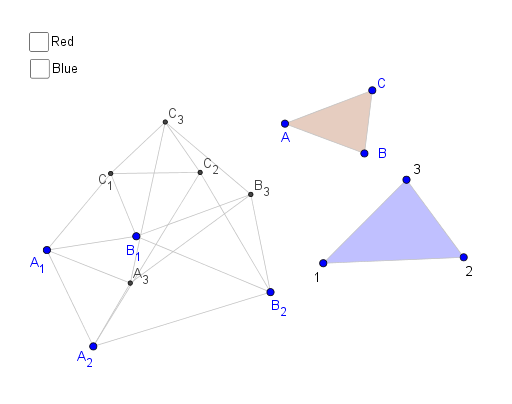
This example demonstrates the construction and properties of two sets of similar triangles. Key math concepts include triangle similarity criteria and properties, geometric transformations, and the integration of circles and polygons. Construction highlights involve GeoGebra commands like Polygon, Rotate, Line, Intersect, Similartriangle, and Segment. Suitable for high school mathematics education to understand triangle similarity theorems and applications.
GeoGebra Commands & Parameters
Polygon(A, B, C) → poly1, c, a, bRotate(A_1, (-Angle[C, B, A]), B_1) → DRotate(B_1, Angle[B, A, C], A_1) → ELine(B_1, D) → fLine(A_1, E) → gIntersect(f, g) → C_1Polygon(C_1, A_1, B_1) → poly2, b_1, c_1, a_1Similartriangle(A, B, C, A_2, B_2) → poly3, C_2Polygon(F, G, H) → poly4, h, f_1, g_1Similartriangle(F, G, H, A_1, A_2) → poly5, A_3Similartriangle(F, G, H, B_1, B_2) → poly6, B_3Similartriangle(F, G, H, C_1, C_2) → poly7, C_3Polygon(A_3, B_3, C_3) → poly8, c_3, a_3, b_3Segment(A_2, B_2) → iSegment(A_2, C_2) → jSegment(C_2, B_2) → kSegment(C_1, C_3) → lSegment(C_3, C_2) → mSegment(C_2, C_1) → nSegment(A_1, A_2) → pSegment(A_2, A_3) → qSegment(A_3, A_1) → rSegment(B_1, B_3) → sSegment(B_3, B_2) → tSegment(B_2, B_1) → h_1