
Two-Body Orbital Trajectories via GeoGebra Parameter Curves
Loading the math board and drawing, please wait…
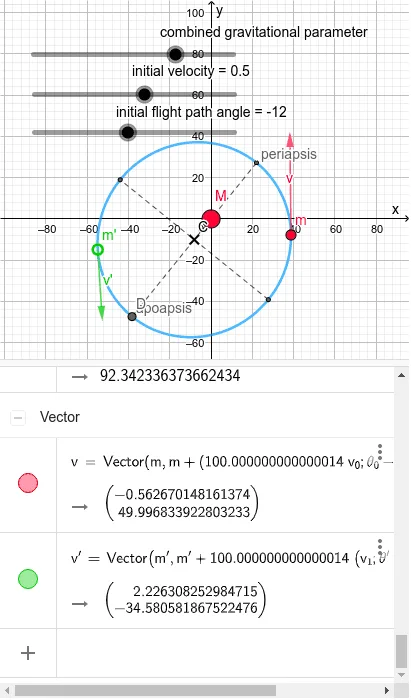
This example demonstrates, in a 2D GeoGebra proof-of-concept visualization, how two-body (Kepler-style) orbital trajectories can be generated from simplified geometric/kinematic relations. It highlights how different initial parameters determine the orbit shape and the key points along the path, such as periapsis and apoapsis, reflecting the role of eccentricity and orbital parameters. The construction centers on parametric-curve graphing and coordinate geometry concepts: vectors, segment-based geometry, angle/length computations, and the classification of conic sections (ellipse/parabola/hyperbola) as orbit families. In GeoGebra terms, the build uses commands including Point, Vector, Segment to define mass/velocity and geometric elements; Length and Angle to compute necessary magnitudes and directions; If to switch formulas or cases depending on parameter conditions; and CurveCartesian to draw the resulting Cartesian-coordinate orbit curve (e.g., the orbit object), along with labeled quantities such as μ, v0, γ0, r0, θ0, eccentricity e, and the major/minor axis parameters (a_maj, a_min) and key points (periapsis/apoapsis). Suitable for advanced high school and early undergraduate learners for visualization of orbital geometry, conic sections, and vector-based modeling.
GeoGebra Commands & Parameters
Length(m) → r_{0}Angle(m) → θ_{0}CurveCartesian((h^(2) / ((μ * (1 + (e * cos(θ - ω))))); θ), θ, 0, (2 * pi)) → orbitVector(m, m + (100 * (v_{0}; θ_{0} + 90° - γ_{0}°))) → v_{→}Point(orbit) → m'Length(m') → r'Angle(m') → θ'Vector(m', m' + (100 * (v'; θ' + 90° - γ'))) → v'_{→}If(ξ < 0, (h^(2) / ((μ * (e - 1))); ω)) → ApoapsisSegment(Periapsis, Apoapsis) → a_{maj}Segment(B, A) → a_{min}
AI Drawing Prompt Reference
Draw a 2D orbital trajectory graph showing two-body orbits in Kepler style. The graph should include an elliptical orbit with marked periapsis and apoapsis, and key points like velocity and position. The construction order should start from defining initial parameters, then draw the orbit curve, and finally label geometric elements.
The prompt above was compiled from the original drawing commands and is for reference only.