
Truncated Cuboctahedron Construction in 3D
Loading the math board and drawing, please wait…
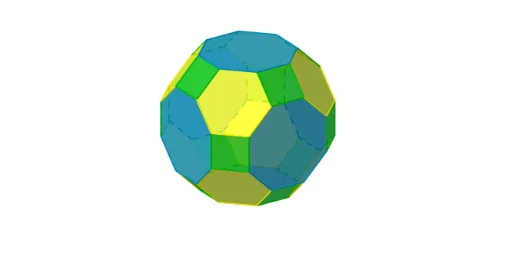
① This example demonstrates how to construct a truncated cuboctahedron, an Archimedean solid with square, regular hexagonal, and regular octagonal faces, using GeoGebra's 3D environment. ② Core mathematical concepts include polyhedral structure (vertices, edges, faces), rotational symmetry, and spatial transformations; the solid is built by rotating and replicating polygons. ③ Construction highlights: from the summary, the Polygon command creates base polygons, and the Rotate command is applied to numerous vertices (e.g., A1-A16, B1-B14, C1-C8) to generate faces and assemble the complete polyhedron; extensive vertex coordinate rotations are involved. ④ Suitable for high school or university solid geometry courses, useful for understanding Archimedean solids and as a teaching example for 3D modeling and geometric transformations.
GeoGebra Commands & Parameters
Polygon(D32, D8, D4, D30, D26, D2, D6, D28) → wielokąt1, d32, d8, d4, d30, d26, d2, d6, d28Rotate(D20, α, Line[D28, D32]) → D20'Rotate(D24, α, Line[D28, D32]) → D24'Polygon(D28, D32, D24', D20') → wielokąt2, d28_1, d32_1, d24', d20'Rotate(D35, α, Line[D2, D6]) → D35'Rotate(D39, α, Line[D2, D6]) → D39'Polygon(D2, D6, D39', D35') → wielokąt3, d2_1, d6_1, d39', d35'Rotate(D23, α, Line[D30, D26]) → D23'Rotate(D19, α, Line[D30, D26]) → D19'Polygon(D30, D26, D19', D23') → wielokąt4, d30_1, d26_1, d19', d23'Rotate(D40, α, Line[D8, D4]) → D40'Rotate(D36, α, Line[D8, D4]) → D36'Polygon(D8, D4, D36', D40') → wielokąt5, d8_1, d4_1, d36', d40'Rotate(D24, β, Line[D32, D8]) → D24'_1Rotate(D48, β, Line[D32, D8]) → D48'Rotate(D16, β, Line[D32, D8]) → D16'Rotate(D40, β, Line[D32, D8]) → D40'_1Polygon(D48', D24'_1, D32, D8, D40'_1, D16') → wielokąt6, d48', d24'_1, d32_2, d8_2, d40'_1, d16'Rotate(D39, β, Line[D6, D28]) → D39'_1Rotate(D15, β, Line[D6, D28]) → D15'Rotate(D46, β, Line[D6, D28]) → D46'Rotate(D20, β, Line[D6, D28]) → D20'_1Polygon(D6, D28, D20'_1, D46', D15', D39'_1) → wielokąt7, d6_2, d28_2, d20'_1, d46', d15', d39'_1Rotate(D19, β, Line[D26, D2]) → D19'_1Rotate(D45, β, Line[D26, D2]) → D45'Rotate(D13, β, Line[D26, D2]) → D13'Rotate(D35, β, Line[D26, D2]) → D35'_1Polygon(D19'_1, D26, D2, D35'_1, D13', D45') → wielokąt8, d19'_1, d26_2, d2_2, d35'_1, d13', d45'Rotate(D36, β, Line[D4, D30]) → D36'_1Rotate(D14, β, Line[D4, D30]) → D14'Rotate(D47, β, Line[D4, D30]) → D47'Rotate(D23, β, Line[D4, D30]) → D23'_1Polygon(D36'_1, D4, D30, D23'_1, D47', D14') → wielokąt9, d36'_1, d4_2, d30_2, d23'_1, d47', d14'Rotate(Rotate[D13, α, Line[D35, D39]], α, Line[D2, D6]) → ARotate(Rotate[D9, α, Line[D35, D39]], α, Line[D2, D6]) → BRotate(Rotate[D33, α, Line[D35, D39]], α, Line[D2, D6]) → CRotate(Rotate[D37, α, Line[D35, D39]], α, Line[D2, D6]) → DRotate(Rotate[D11, α, Line[D35, D39]], α, Line[D2, D6]) → ERotate(Rotate[D15, α, Line[D35, D39]], α, Line[D2, D6]) → FPolygon(D39', F, E, D, C, B, A, D35') → wielokąt10, d39'_2, f, e, d, c, b_1, a_1, d35'_2Rotate(Rotate[D47, α, Line[D23, D19]], α, Line[D30, D26]) → GRotate(Rotate[D43, α, Line[D23, D19]], α, Line[D30, D26]) → HRotate(Rotate[D21, α, Line[D23, D19]], α, Line[D30, D26]) → IRotate(Rotate[D17, α, Line[D23, D19]], α, Line[D30, D26]) → JRotate(Rotate[D41, α, Line[D23, D19]], α, Line[D30, D26]) → KRotate(Rotate[D45, α, Line[D23, D19]], α, Line[D30, D26]) → LPolygon(D19', L, K, J, I, H, G, D23') → wielokąt11, d19'_2, l, k_1, j, i, h, g, d23'_2Rotate(Rotate[D16, α, Line[D40, D36]], α, Line[D8, D4]) → MRotate(Rotate[D12, α, Line[D40, D36]], α, Line[D8, D4]) → NRotate(Rotate[D38, α, Line[D40, D36]], α, Line[D8, D4]) → ORotate(Rotate[D34, α, Line[D40, D36]], α, Line[D8, D4]) → PRotate(Rotate[D10, α, Line[D40, D36]], α, Line[D8, D4]) → QRotate(Rotate[D14, α, Line[D40, D36]], α, Line[D8, D4]) → RPolygon(D40', D36', R, Q, P, O, N, M) → wielokąt12, d40'_2, d36'_2, r, q, p, o, n, mRotate(Rotate[D46, α, Line[D20, D24]], α, Line[D28, D32]) → SRotate(Rotate[D42, α, Line[D20, D24]], α, Line[D28, D32]) → TRotate(Rotate[D18, α, Line[D20, D24]], α, Line[D28, D32]) → URotate(Rotate[D22, α, Line[D20, D24]], α, Line[D28, D32]) → VRotate(Rotate[D44, α, Line[D20, D24]], α, Line[D28, D32]) → WRotate(Rotate[D48, α, Line[D20, D24]], α, Line[D28, D32]) → ZPolygon(D20', D24', Z, W, V, U, T, S) → wielokąt13, d20'_2, d24'_2, z_1, w, v, u, t, s_3Rotate(Rotate[Rotate[D43, α, Line[D10, D14]], α, Line[D40, D36]], α, Line[D8, D4]) → A_1Rotate(Rotate[Rotate[D47, α, Line[D10, D14]], α, Line[D40, D36]], α, Line[D8, D4]) → B_1Polygon(R, B_1, A_1, Q) → wielokąt14, r_1, b_2, a_2, q_1Rotate(Rotate[Rotate[D12, α, Line[D44, D48]], α, Line[D20, D24]], α, Line[D28, D32]) → C_1Rotate(Rotate[Rotate[D16, α, Line[D44, D48]], α, Line[D20, D24]], α, Line[D28, D32]) → D_1Polygon(Z, D_1, C_1, W) → wielokąt15, z_2, d_1, c_1, w_1Rotate(Rotate[Rotate[D42, α, Line[D11, D15]], α, Line[D35, D39]], α, Line[D2, D6]) → E_1Rotate(Rotate[Rotate[D46, α, Line[D11, D15]], α, Line[D35, D39]], α, Line[D2, D6]) → F_1Polygon(F, F_1, E_1, E) → wielokąt16, f_1, f_2, e_1, e_2Rotate(Rotate[Rotate[D9, α, Line[D41, D45]], α, Line[D23, D19]], α, Line[D30, D26]) → G_1Rotate(Rotate[Rotate[D13, α, Line[D41, D45]], α, Line[D23, D19]], α, Line[D30, D26]) → H_1Polygon(L, H_1, G_1, K) → wielokąt17, l_1, h_1, g_1, k_2Rotate(Rotate[Rotate[D25, β, Line[D17, D41]], α, Line[D23, D19]], α, Line[D30, D26]) → I_1Rotate(Rotate[Rotate[D1, β, Line[D17, D41]], α, Line[D23, D19]], α, Line[D30, D26]) → J_1Rotate(Rotate[Rotate[D33, β, Line[D17, D41]], α, Line[D23, D19]], α, Line[D30, D26]) → K_1Rotate(Rotate[Rotate[D9, β, Line[D17, D41]], α, Line[D23, D19]], α, Line[D30, D26]) → L_1Polygon(K, L_1, K_1, J_1, I_1, J) → wielokąt18, k_3, l_2, k_4, j_1, i_1, j_2Rotate(Rotate[Rotate[D3, β, Line[D34, D10]], α, Line[D40, D36]], α, Line[D8, D4]) → M_1Rotate(Rotate[Rotate[D29, β, Line[D34, D10]], α, Line[D40, D36]], α, Line[D8, D4]) → N_1Rotate(Rotate[Rotate[D21, β, Line[D34, D10]], α, Line[D40, D36]], α, Line[D8, D4]) → O_1Rotate(Rotate[Rotate[D43, β, Line[D34, D10]], α, Line[D40, D36]], α, Line[D8, D4]) → P_1Polygon(Q, P_1, O_1, N_1, M_1, P) → wielokąt19, q_2, p_1, o_1, n_1, m_1, p_2Rotate(Rotate[Rotate[D31, β, Line[D22, D44]], α, Line[D20, D24]], α, Line[D28, D32]) → Q_1Rotate(Rotate[Rotate[D7, β, Line[D22, D44]], α, Line[D20, D24]], α, Line[D28, D32]) → R_1Rotate(Rotate[Rotate[D38, β, Line[D22, D44]], α, Line[D20, D24]], α, Line[D28, D32]) → S_1Rotate(Rotate[Rotate[D12, β, Line[D22, D44]], α, Line[D20, D24]], α, Line[D28, D32]) → T_1Polygon(V, W, T_1, S_1, R_1, Q_1) → wielokąt20, v_1, w_2, t_1, s_1, r_2, q_3Rotate(Rotate[Rotate[D5, β, Line[D37, D11]], α, Line[D35, D39]], α, Line[D2, D6]) → U_1Rotate(Rotate[Rotate[D27, β, Line[D37, D11]], α, Line[D35, D39]], α, Line[D2, D6]) → V_1Rotate(Rotate[Rotate[D18, β, Line[D37, D11]], α, Line[D35, D39]], α, Line[D2, D6]) → W_1Rotate(Rotate[Rotate[D42, β, Line[D37, D11]], α, Line[D35, D39]], α, Line[D2, D6]) → Z_1Polygon(E, Z_1, W_1, V_1, U_1, D) → wielokąt21, e_3, z_3, w_3, v_2, u_1, d_2Rotate(Rotate[Rotate[D1, α, Line[D33, D37]], α, Line[D35, D39]], α, Line[D2, D6]) → A_2Rotate(Rotate[Rotate[D5, α, Line[D33, D37]], α, Line[D35, D39]], α, Line[D2, D6]) → B_2Polygon(C, D, B_2, A_2) → wielokąt22, c_2, d_3, b_3, a_3Rotate(Rotate[Rotate[D29, α, Line[D21, D17]], α, Line[D23, D19]], α, Line[D30, D26]) → C_2Rotate(Rotate[Rotate[D25, α, Line[D21, D17]], α, Line[D23, D19]], α, Line[D30, D26]) → D_2Polygon(I, J, D_2, C_2) → wielokąt23, i_2, j_3, d_4, c_3Rotate(Rotate[Rotate[D7, α, Line[D38, D34]], α, Line[D40, D36]], α, Line[D8, D4]) → E_2Rotate(Rotate[Rotate[D3, α, Line[D38, D34]], α, Line[D40, D36]], α, Line[D8, D4]) → F_2Polygon(O, P, F_2, E_2) → wielokąt24, o_2, p_3, f_3, e_4Rotate(Rotate[Rotate[D27, α, Line[D18, D22]], α, Line[D20, D24]], α, Line[D28, D32]) → G_2Rotate(Rotate[Rotate[D31, α, Line[D18, D22]], α, Line[D20, D24]], α, Line[D28, D32]) → H_2Polygon(U, V, H_2, G_2) → wielokąt25, u_2, v_3, h_2, g_2Rotate(Rotate[Rotate[Rotate[D5, α, Line[D27, D31]], α, Line[D18, D22]], α, Line[D20, D24]], α, Line[D28, D32]) → I_2Rotate(Rotate[Rotate[Rotate[D1, α, Line[D27, D31]], α, Line[D18, D22]], α, Line[D20, D24]], α, Line[D28, D32]) → J_2Rotate(Rotate[Rotate[Rotate[D25, α, Line[D27, D31]], α, Line[D18, D22]], α, Line[D20, D24]], α, Line[D28, D32]) → K_2Rotate(Rotate[Rotate[Rotate[D29, α, Line[D27, D31]], α, Line[D18, D22]], α, Line[D20, D24]], α, Line[D28, D32]) → L_2Rotate(Rotate[Rotate[Rotate[D3, α, Line[D27, D31]], α, Line[D18, D22]], α, Line[D20, D24]], α, Line[D28, D32]) → M_2Rotate(Rotate[Rotate[Rotate[D7, α, Line[D27, D31]], α, Line[D18, D22]], α, Line[D20, D24]], α, Line[D28, D32]) → N_2Polygon(H_2, N_2, M_2, L_2, K_2, J_2, I_2, G_2) → wielokąt26, h_3, n_2, m_2, l_3, k_5, j_4, i_3, g_3
AI Drawing Prompt Reference
Construct a truncated cuboctahedron by first creating square, regular hexagonal, and regular octagonal polygons as base shapes, then generating faces by rotating these polygons. Specifically, rotate D20 and D24 around D28 and D32 to create D20' and D24', and use D28 and D32 as axes to generate wielokąt2; next, rotate D35 and D39 around D28 and D32 to create D35' and D39', and use D2 and D6 as axes to generate wielokąt3; continue by rotating D23 and D19 around D30 and D26 to create D23' and D19', and use D30 and D26 as axes to generate wielokąt4; finally, rotate D40 and D36 around D8 and D4 to create D40' and D36', and use D8 and D4 as axes to generate wielokąt5.
The prompt above was compiled from the original drawing commands and is for reference only.