
Trisecting a Rectangular Prism by Joel Friedman
Loading the math board and drawing, please wait…
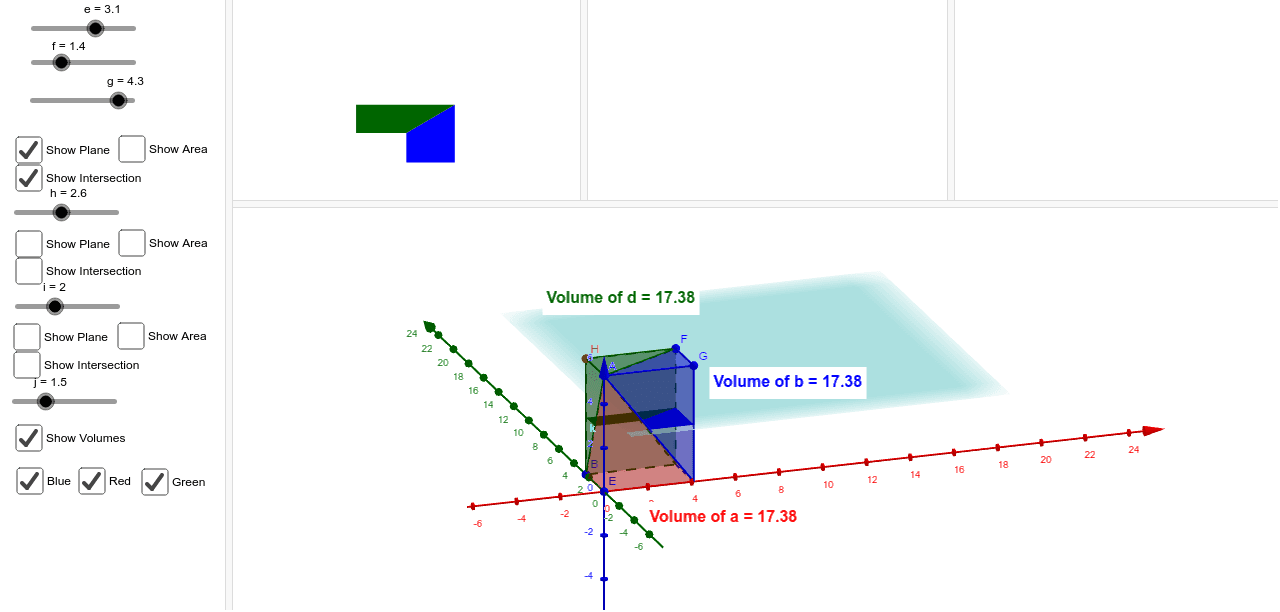
This example demonstrates the geometric construction of trisecting the volume of a rectangular prism. It involves core concepts in solid geometry, volume calculation, vector operations, and polygonal/triangular pyramid formation. GeoGebra commands and objects like Pyramid, Plane, IntersectPath, PointIn, Volume, and Point are utilized in the construction. Suitable for high school and above students learning about spatial geometry, volume partitioning, and geometric constructions.
GeoGebra Commands & Parameters
Pyramid(E, B, D, C, A) → a, faceBDCE, edgeAE, edgeAB_1, edgeAD_1, edgeAC_1, faceABE, faceABD_1, faceACD_1, faceACE, edgeBE, edgeBD_1, edgeCD_1, edgeCEPyramid(G, F, D, C, A) → b, faceCDFG, edgeAG, edgeAF_1, edgeAD_2, edgeAC, faceAFG, faceADF_1, faceACD, faceACG, edgeFG, edgeDF_1, edgeCD, edgeCGPyramid(faceADF_1, F) → c, faceDFF, faceADF_2, faceAFF, edgeFF, edgeDF_1, edgeAF_1Pyramid(H, B, D, F, A) → d, faceBDFH, edgeAH, edgeAB, edgeAD, edgeAF, faceABH, faceABD, faceADF, faceAFH, edgeBH, edgeBD, edgeDF, edgeFHPlane(I, faceAFG) → kPlane(J, faceACE) → lPlane(K, faceCDFG) → mIntersectPath(k, b) → poly1, L, M, N, O, q, r, s, tIntersectPath(k, d) → poly2, poly3, c_1, d_1, e_1, f_1, P, Q, R, S, T, U, a_1, b_1IntersectPath(l, a) → poly4, poly6, i_1, j_1, p_1, q_1, V, W, Z, A_1, F_1, G_1, g_1, h_1IntersectPath(l, b) → poly5, poly7, m_1, n_1, r_1, s_1, B_1, C_1, D_1, E_1, H_1, I_1, k_1, l_1IntersectPath(m, a) → poly8, poly10, b_2, c_2, h_2, i_2, J_1, K_1, L_1, M_1, R_1, S_1, t_1, a_2IntersectPath(m, d) → poly9, poly11, f_2, g_2, j_2, k_2, N_1, O_1, P_1, Q_1, T_1, U_1, d_2, e_2PointIn(faceABH) → PointfaceABHPointIn(faceABE) → PointfaceABEPointIn(poly9) → Pointpoly9_1PointIn(poly8) → Pointpoly8_1PointIn(faceACG) → PointfaceACGPointIn(faceACE) → PointfaceACEPointIn(poly5) → Pointpoly5_1PointIn(poly4) → Pointpoly4_1PointIn(poly2) → Pointpoly2_1PointIn(poly1) → Pointpoly1_1PointIn(poly5) → Pointpoly5_2PointIn(poly4) → Pointpoly4_2PointIn(poly9) → Pointpoly9_2PointIn(poly8) → Pointpoly8_2Volume(d) → volumedPoint(d) → Pointd_1Volume(b) → volumebPoint(b) → Pointb_1Volume(d) → o_1Point(d) → Pointd_2PointIn(poly2) → Pointpoly2_2PointIn(poly1) → Pointpoly1_2Volume(d) → l_2Point(d) → Pointd_3Volume(b) → m_2Point(b) → PointbVolume(a) → volumeaPoint(a) → PointaVolume(d) → n_2Point(d) → PointdPointIn(poly2) → Pointpoly2_3PointIn(poly1) → Pointpoly1_3PointIn(poly2) → Pointpoly2_4PointIn(poly1) → Pointpoly1_4PointIn(poly5) → Pointpoly5PointIn(poly4) → Pointpoly4PointIn(poly9) → Pointpoly9_3PointIn(poly8) → Pointpoly8PointIn(poly9) → Pointpoly9PointIn(poly2) → Pointpoly2PointIn(poly1) → Pointpoly1
AI Drawing Prompt Reference
Draw a rectangular prism and trisect its volume. Construct four triangular pyramids using different vertices of the prism as apexes and faces or diagonal planes as bases. Then, create three cutting planes, each passing through a specific face of a pyramid, intersecting the pyramids to form multiple intersection paths and polygonal cross-sections. Finally, place random points inside the resulting faces and polygons, and compute the volumes of the pyramids to verify the trisection. The figure illustrates spatial volume partitioning and cross-section construction.
The prompt above was compiled from the original drawing commands and is for reference only.