
Trigonometry Word Problem: Planet Radius and Satellite Viewing Angle
Loading the math board and drawing, please wait…
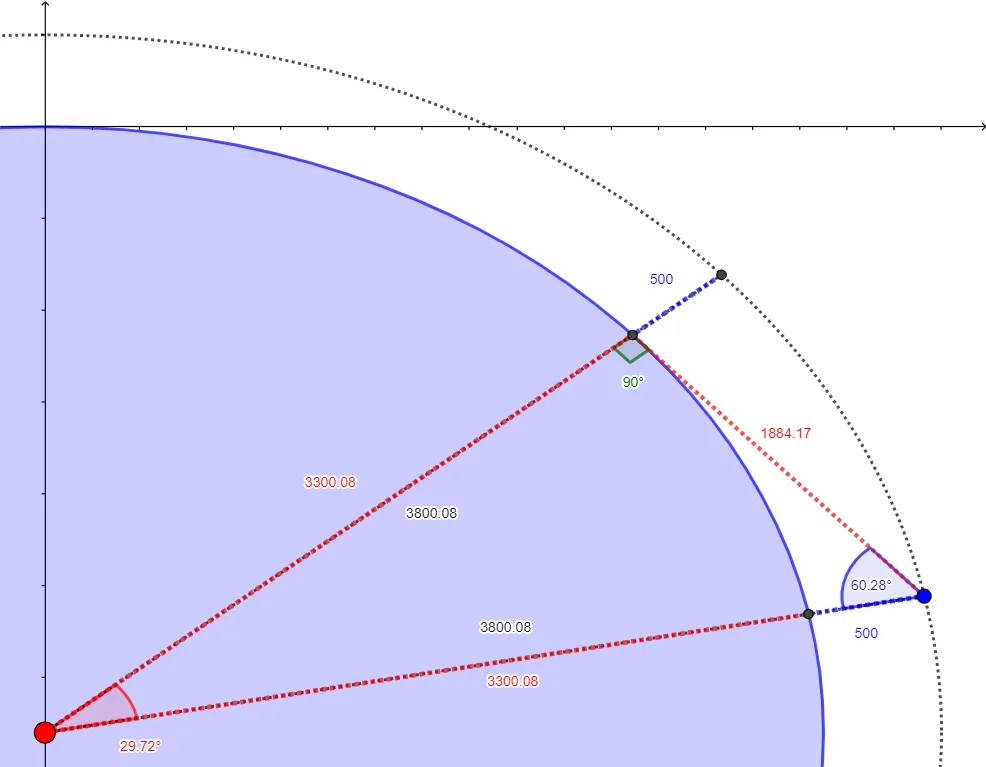
This GeoGebra example dynamically demonstrates a trigonometry word problem: given the viewing angle and separation distance of an artificial satellite from a planet, determine the planet's radius. The construction includes a circle representing the planet, a point for the satellite, tangent segments, and labeled angles, making the geometric relationships visually clear. Core mathematical concepts include trigonometric functions (sine, cosine), circle properties, angle measurement, and distance calculation. The construction uses commands such as Circle, Segment, Angle, Length, and Rotate, along with interactive text fields and sliders (CasillaDeEntrada) to adjust parameters and see real-time updates. Suitable for high school or early college students learning applied trigonometry, and useful for teachers as a dynamic classroom demonstration.
GeoGebra Commands & Parameters
Textfield(d) → CasillaDeEntrada1Textfield(aV) → CasillaDeEntrada2Circle(A, rP) → cCircle(A, rP + d) → eTextfield(aR) → CasillaDeEntrada3Rotate(B, aR, A) → B'Rotate(C, aR, A) → C'Segment(A, B') → fSegment(A, C') → gIntersect(c, f) → D,Intersect(c, g) → E,Segment(A, D) → iSegment(B', D) → jSegment(E, C') → kSegment(A, E) → lAngle(E, A, D) → αLength(g) → xmaxSegment(D, C') → hAngle(A, D, C') → βAngle(D, C', A) → γ
AI Drawing Prompt Reference
Draw a circle for a planet with a point for a satellite. Adjust the distance between the satellite and the planet's center using a slider. Draw two tangent lines from the satellite to the circle, creating two points of tangency. Adjust the angle between the satellite and the tangent lines using a slider. Display the angle at the center of the circle, measure and label the tangent lengths, and show the trigonometric relationships to dynamically demonstrate how to calculate the planet's radius.
The prompt above was compiled from the original drawing commands and is for reference only.