
Trigonometric Ratios in Similar Triangles by Dave Pfaffle
Loading the math board and drawing, please wait…
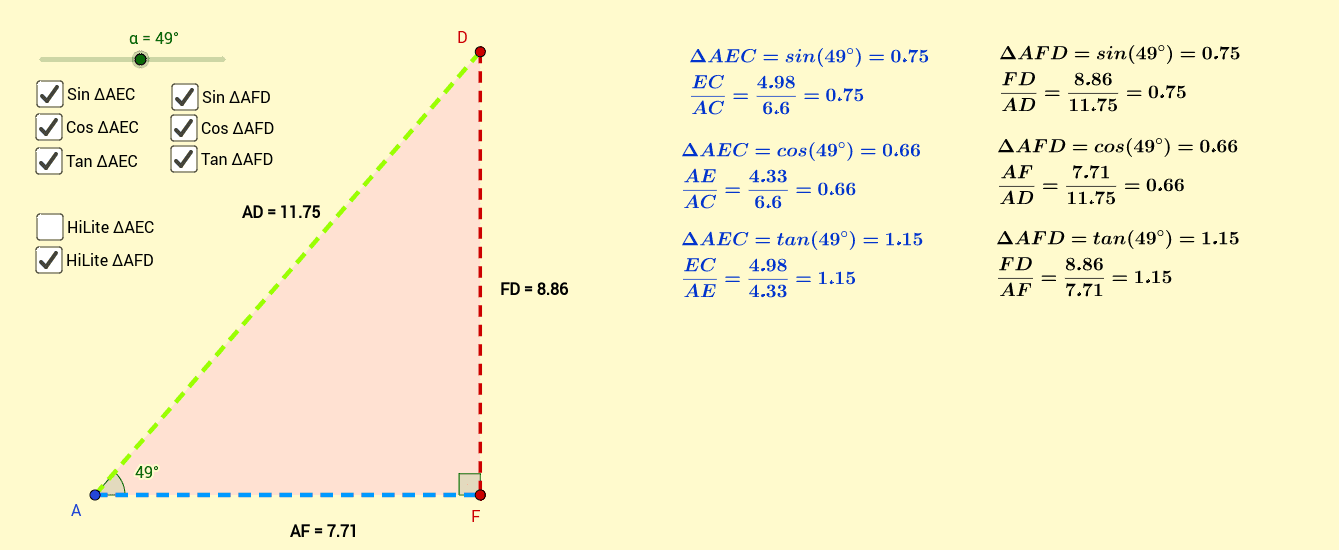
① This GeoGebra example demonstrates that in similar right triangles, the trigonometric ratios (sine, cosine, tangent) for a given angle remain constant regardless of the triangle's size. ② Core mathematical concepts include similarity of triangles, definitions of trigonometric ratios (opposite/hypotenuse, adjacent/hypotenuse, opposite/adjacent), and proportional relationships. ③ Construction highlights: using GeoGebra commands such as Intersect, Point, Ray, Rotate, Angle, OrthogonalLine, Distance, Segment, and Polygon, the applet builds multiple similar right triangles, measures side lengths (e.g., distanceAC, distanceAE, distanceEC) and angles (α, β, γ, δ) to verify the constancy of ratios. ④ Suitable for upper middle school or early high school students learning introductory trigonometry, and for teachers to illustrate the connection between similarity and trigonometric ratios.
GeoGebra Commands & Parameters
Intersect(xAxis, yAxis) → APoint(xAxis) → BRay(A, B) → fRotate(B, α, A) → B'Angle(B, A, B') → βRay(A, B') → gPoint(g) → CPoint(g) → DOrthogonalLine(C, f) → hOrthogonalLine(D, f) → iIntersect(h, f) → EIntersect(i, f) → FAngle(C, E, A) → γAngle(D, F, A) → δDistance(A, C) → distanceACDistance(A, E) → distanceAEDistance(E, C) → distanceECDistance(A, F) → distanceAFDistance(F, D) → distanceFDDistance(A, D) → distanceADSegment(C, E) → jSegment(D, F) → kDistance(F, D) → FDDistance(A, D) → ADPolygon(E, C, A) → poly1, a_1, e, c_1Segment(A, D) → lSegment(A, F) → mPolygon(A, F, D) → poly2, d_1, a_2, f_1