
Difference Numbers Model: Random Visualization of Cubes, Rods, and Number Repres
Loading the math board and drawing, please wait…
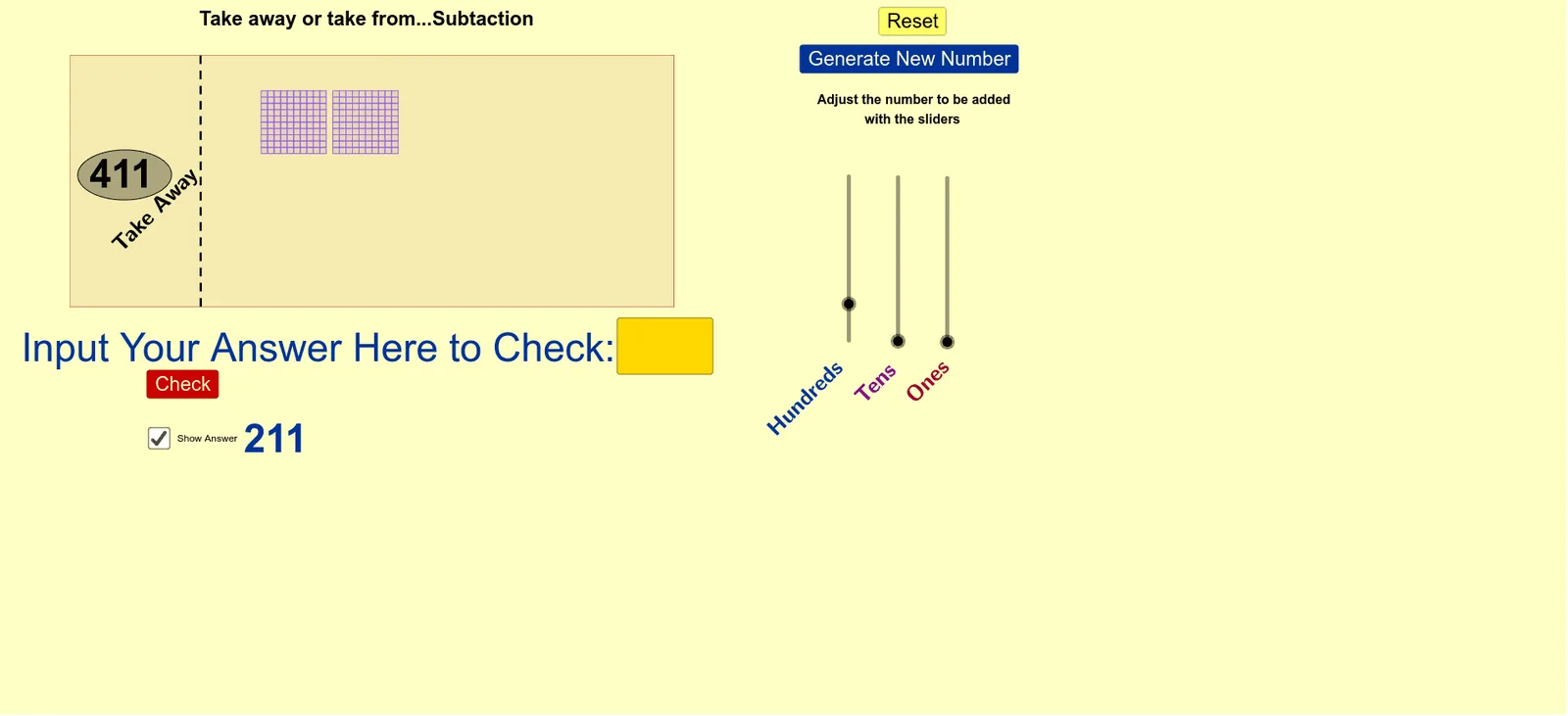
This GeoGebra example demonstrates a number model based on the concept of Difference Numbers, generating various digital representations through random processes. Key mathematical concepts include: stochastic processes (using Random command to generate random numbers), 2D vector representations, and geometric transformations and arrangements. Construction highlights: Sequence command creates number sequences, Point command defines key points, Random command generates random values, RotateText rotates labels, Ellipse draws ellipses, Polygon constructs polygons, Segment draws line segments, and Textfield creates interactive input fields. Objects include multiple coordinate points (A, B, E, F, I, J, M, N, Q, R with subscript variants), list objects (list24, list25), text boxes (text1-text6), and button controls (button1). This model is suitable for elementary to middle school mathematics teaching, helping students understand place value concepts (ones, tens, hundreds), probability meanings of random events, and intuitively grasp mathematical patterns through geometric representations.
GeoGebra Commands & Parameters
Sequence((i, 23), i, 70, 88, 2) → list24Point(list24) → APoint(list24) → BPoint(list24) → EPoint(list24) → FPoint(list24) → IPoint(list24) → JPoint(list24) → MPoint(list24) → NPoint(list24) → QPoint(list24) → RSequence((i, 27), i, 70, 88, 2) → list25Point(list25) → UPoint(list25) → VPoint(list25) → A_1Point(list25) → B_1Point(list25) → E_1Point(list25) → F_1Point(list25) → I_1Point(list25) → J_1Point(list25) → M_1Point(list25) → N_1Point(list25) → Q_1Point(list25) → R_1Point(list24) → U_1Point(list24) → V_1Random(1, 9) → rhundRandom(0, 9) → rtenRandom(0, 9) → roneRotateText(text4, 45°) → text10RotateText(text5, 45°) → text11RotateText(text6, 45°) → text12Ellipse(A_2, B_2, C_2) → c_2Polygon(D_2, E_2, F_2, G_2) → poly13, d_2, e_2, f_3, g_3Point(g_3) → H_2Point(e_2) → I_2Segment(H_2, I_2) → q_2Textfield(YourGuess) → InputBox1RotateText(text17, 45°) → text18Point(list25) → CPoint(list25) → DPolygon(C, D, 4) → poly1, f, g, h, i, G, HPoint(list25) → KPoint(list25) → LPolygon(K, L, 4) → poly2, j, k, l, m, O, PPoint(list25) → SPoint(list25) → TPolygon(T, S, 4) → poly3, n, p, q, r, W, ZPoint(list25) → C_1Point(list25) → D_1Polygon(D_1, C_1, 4) → poly4, s, t, a, b, G_1, H_1Point(list25) → K_1Point(list25) → L_1Polygon(K_1, L_1, 4) → poly5, c, d, e, f_1, O_1, P_1Point(list24) → S_1Point(list24) → T_1Polygon(T_1, S_1, 4) → poly6, g_1, h_1, i_1, j_1, W_1, Z_1Point(list24) → J_2Point(list24) → K_2Polygon(J_2, K_2, 4) → poly7, k_1, l_1, m_1, n_1, L_2, M_2Point(list24) → N_2Point(list24) → O_2Polygon(N_2, O_2, 4) → poly8, p_1, q_1, r_1, s_1, P_2, Q_2Point(list24) → R_2Point(list24) → S_2Polygon(R_2, S_2, 4) → poly9, t_1, a_1, b_1, c_1, T_2, U_2Point(list24) → V_2Point(list24) → W_2Polygon(V_2, W_2, 4) → poly10, d_1, e_1, f_2, g_2, Z_2, A_3Sequence(Polygon[(68, i), (68, i + 1), 4], i, 22, 31) → list15Sequence(Polygon[(68, i), (68, i + 1), 4], i, 11, 20) → list19Sequence(Polygon[(68, i), (68, i + 1), 4], i, 0, 9) → list14Sequence(Polygon[(66, i), (66, i + 1), 4], i, 0, 9) → list13Sequence(Polygon[(66, i), (66, i + 1), 4], i, 11, 20) → list20Sequence(Polygon[(66, i), (66, i + 1), 4], i, 22, 31) → list17Sequence(Polygon[(64, i), (64, i + 1), 4], i, 22, 31) → list18Sequence(Polygon[(64, i), (64, i + 1), 4], i, 11, 20) → list21Sequence(Polygon[(64, i), (64, i + 1), 4], i, 0, 9) → list12Sequence(Sequence[Polygon[(j, i), (j, i + 1), 4], i, 22, 31], j, 53, 62) → list11Sequence(Sequence[Polygon[(j, i), (j, i + 1), 4], i, 11, 20], j, 53, 62) → list8Sequence(Sequence[Polygon[(j, i), (j, i + 1), 4], i, 0, 9], j, 53, 62) → list6Sequence(Sequence[Polygon[(j, i), (j, i + 1), 4], i, 22, 31], j, 42, 51) → list10Sequence(Sequence[Polygon[(j, i), (j, i + 1), 4], i, 11, 20], j, 42, 51) → list4Sequence(Sequence[Polygon[(j, i), (j, i + 1), 4], i, 0, 9], j, 42, 51) → list5Sequence(Sequence[Polygon[(j, i), (j, i + 1), 4], i, 0, 9], j, 31, 40) → list1Sequence(Sequence[Polygon[(j, i), (j, i + 1), 4], i, 11, 20], j, 31, 40) → list2Sequence(Sequence[Polygon[(j, i), (j, i + 1), 4], i, 22, 31], j, 31, 40) → list3Sequence(Sequence[Polygon[(i, j), (i + 4, j), 4], i, 69, 87, 4], j, 22, 26, 4) → list23
AI Drawing Prompt Reference
This is a random visualization model based on difference numbers, containing multiple points, sequences, and randomly generated numbers. Points A, B, E, F, I, J, M, N, Q, R, U, V, A_1, B_1, etc. represent different values. Random commands generate random numbers used for rotating text and drawing ellipses, line segments, and triangles. The model helps students understand place value concepts and probability meanings through geometric representations, intuitively showcasing mathematical patterns.
The prompt above was compiled from the original drawing commands and is for reference only.