
Trigonometric Functions with the Unit Circle
Loading the math board and drawing, please wait…
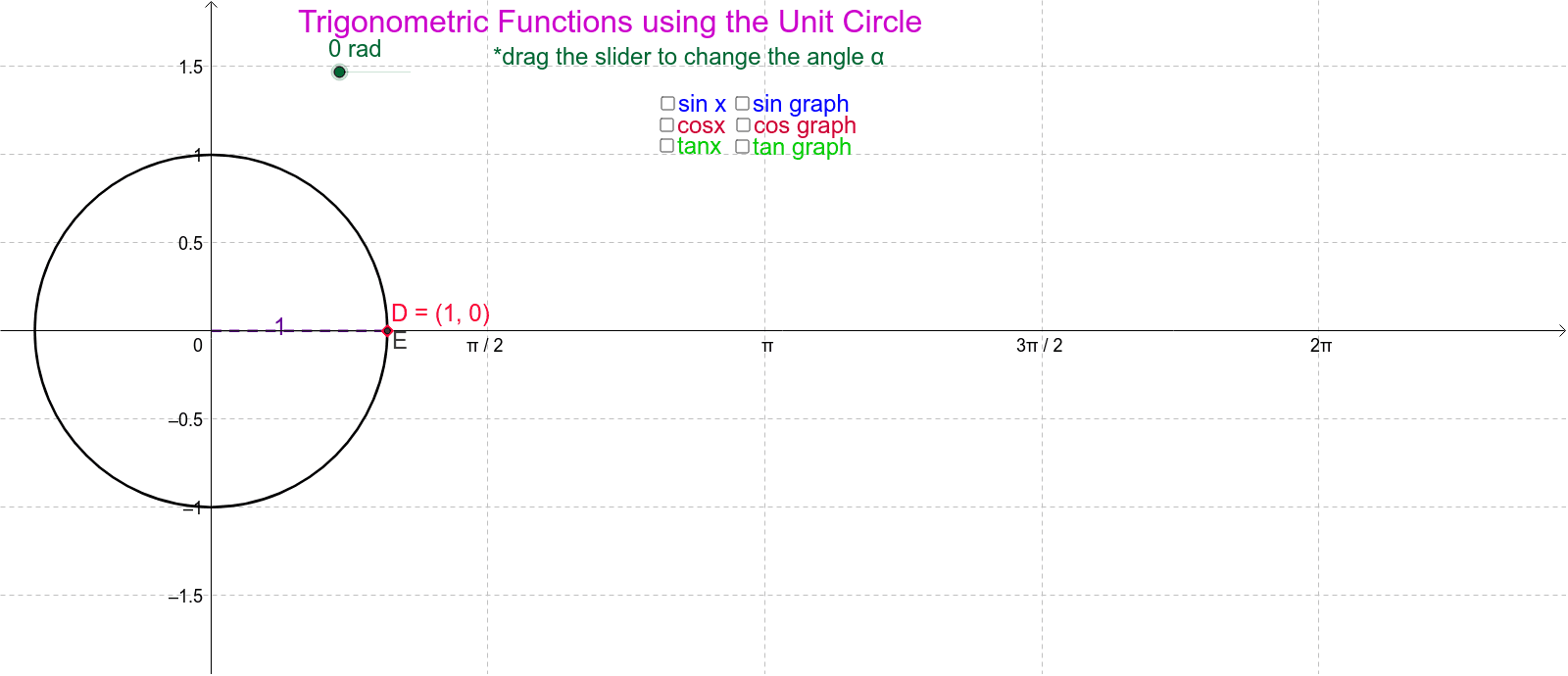
This example dynamically demonstrates how changing the angle on the unit circle affects its trigonometric functions and corresponding graphs using a slider. Core concepts include the unit circle, sine, cosine, tangent functions, angles, and function graphing. It is constructed using GeoGebra commands like Intersect, Circle, Point, Segment, Rotate, Angle, and Ray. Ideal for high school mathematics instruction to visually understand trigonometric definitions and graph properties.
GeoGebra Commands & Parameters
Intersect(xAxis, yAxis) → ACircle(A, 1) → cPoint(c) → BSegment(C, B) → bRotate(C, α_1, A) → C'Angle(C, A, C') → αRay(A, C') → aIntersect(c, a) → D,Segment(A, D) → eSegment(E, D) → fSegment(A, E) → d
AI Drawing Prompt Reference
Draw a unit circle with an origin on the coordinate axes. Start a ray from the origin and mark a point on it. Rotate this point around the origin by an angle to get a new point. Connect the origin to this new point to form a line segment. Also, connect the origin to the intersection point of the ray and the unit circle to form another line segment. Finally, draw the line segment from the origin to the intersection point, showing the relationships between these segments and the unit circle to dynamically demonstrate how changing the angle affects trigonometric functions.
The prompt above was compiled from the original drawing commands and is for reference only.