
Angles Formed by Parallel Lines
Loading the math board and drawing, please wait…
In collections
Angles 1
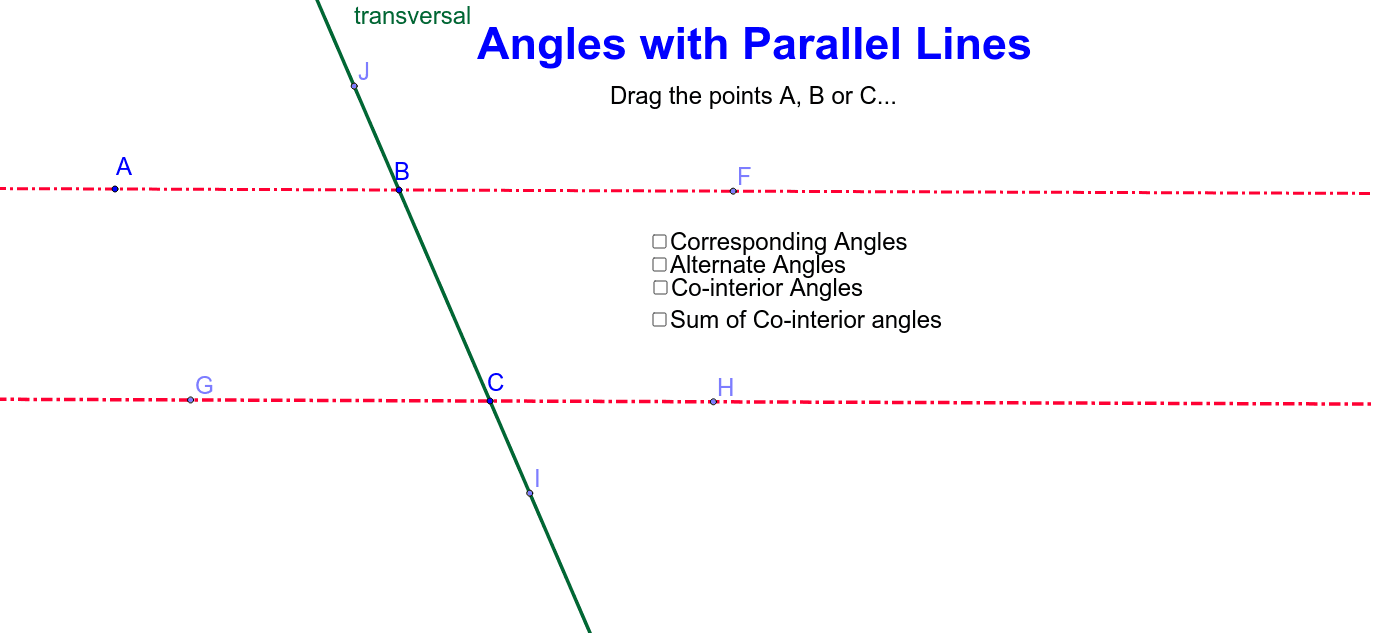
This example demonstrates the relationships between angles formed when parallel lines are cut by a transversal, including alternate interior, corresponding, and consecutive interior angles. Key mathematical concepts involve properties of parallel lines, angle relationships, and geometric constructions. It is constructed using GeoGebra commands such as Line, Angle, and Point to draw parallel lines, transversals, and measure angles. Suitable for middle school and high school students studying geometry and parallel line properties.
GeoGebra Commands & Parameters
Line(A, B) → aLine(C, a) → bLine(B, C) → transversalAngle(transversal, a) → αAngle(transversal, b) → βAngle(A, B, C) → γPoint(b) → DAngle(B, C, D) → δAngle(A, B, C) → εPoint(b) → EAngle(E, C, B) → ζPoint(a) → FPoint(b) → GPoint(b) → HPoint(transversal) → IPoint(transversal) → JAngle(J, B, A) → ηAngle(A, B, C) → θAngle(B, C, G) → ιAngle(G, C, I) → κAngle(C, B, F) → λAngle(H, C, B) → μ