
Trigonometric Factorisation Subtraction Identity Geometric Demonstration
Loading the math board and drawing, please wait…
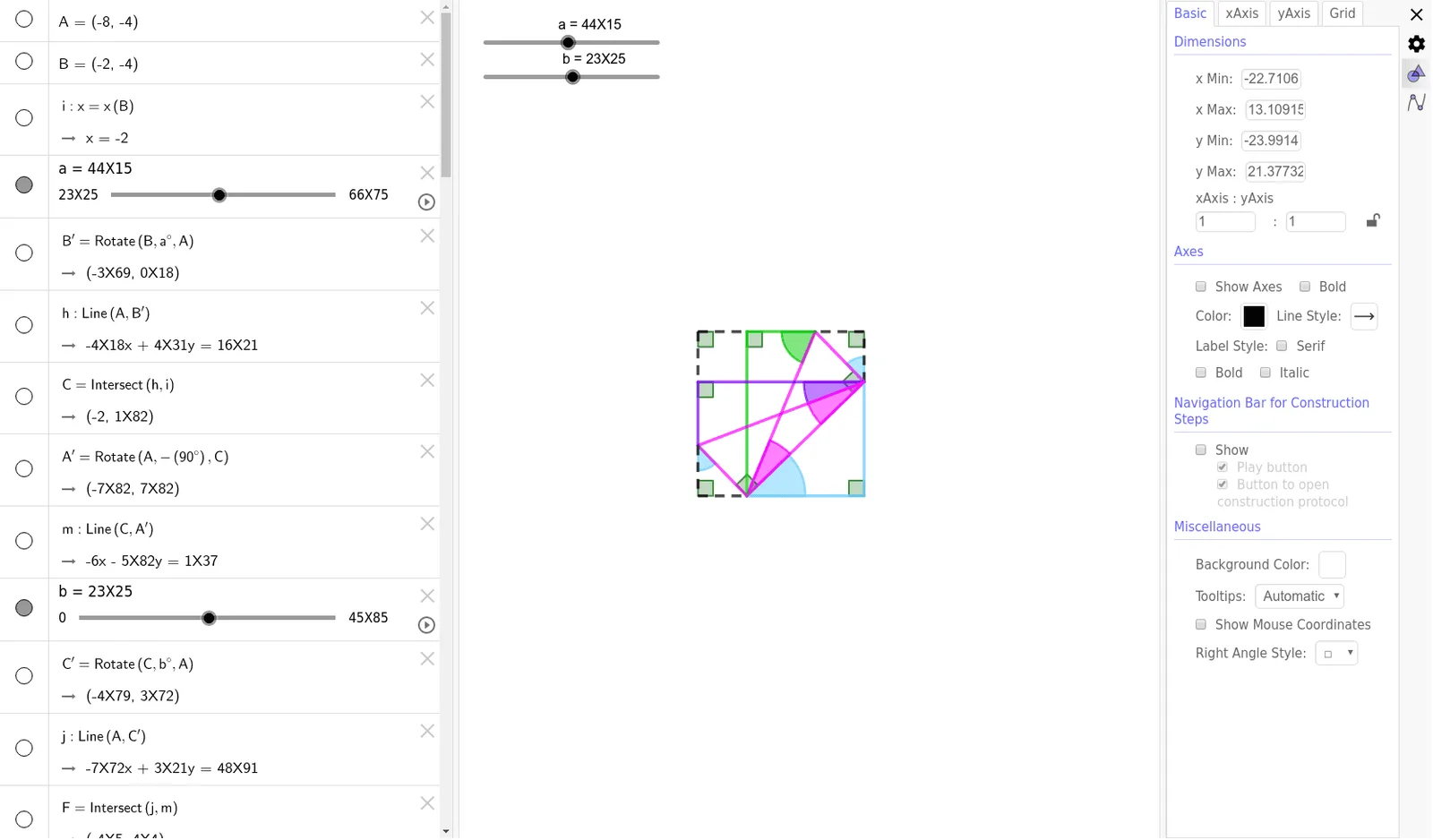
This GeoGebra example dynamically demonstrates a subtraction identity in trigonometric factorisation, such as the factored form of sin(A-B) or cos(A-B), through geometric construction. The core mathematical concepts include trigonometric sum/difference formulas, factorisation, and angle relationships in geometric figures. Construction highlights: using commands like Rotate, Line, Intersect, Segment, and Angle, the construction builds quadrilaterals, equilateral triangles, rectangles, and other shapes, with auxiliary points (A', B', C', etc.) and lines (h, m, j, etc.) linking angles α, β, γ, δ, etc. The identity is verified through logical reasoning and the concepts of difference and slope. Suitable for high school or early college students to grasp the geometric meaning of trigonometric identities, and useful for teachers creating dynamic lessons or students exploring mathematics independently.
GeoGebra Commands & Parameters
Rotate(B, a°, A) → B'Line(A, B') → hIntersect(h, i) → CRotate(A, (-(90°)), C) → A'Line(C, A') → mRotate(C, b°, A) → C'Line(A, C') → jIntersect(j, m) → FIntersect(i, k) → DSegment(D, F) → cSegment(C, D) → tAngle(B, A, B') → αSegment(A, B) → fLine(A, B) → gAngle(C, A, C') → βAngle(A', C, A) → γLine(A, E) → lSegment(A, F) → pSegment(A, C) → qSegment(C, F) → rSegment(B, C) → sSegment(F, E) → dSegment(E, A) → eSegment(C, G) → f_1Segment(G, H) → g_1Segment(H, A) → h_1Angle(E, F, A) → δRotate(C, 90°, A) → C'_1Angle(C, A, C'_1) → ζLine(C'_1, A) → i_1Intersect(i_1, g_1) → ISegment(I, A) → j_1Segment(I, C) → k_1Angle(A, H, I) → εAngle(I, G, C) → ηAngle(A, E, F) → θAngle(F, D, C) → ιAngle(C, B, A) → κAngle(I, C, A) → λAngle(H, I, A) → μAngle(G, C, I) → ξAngle(D, C, F) → νSegment(G, I) → l_1Segment(I, H) → m_1Line(G, H) → n_1Intersect(k, n_1) → JSegment(J, E) → p_1Segment(J, G) → q_1Angle(G, J, E) → ο