
Triangle Similarity: Definition, Criteria, and Demonstrations
Loading the math board and drawing, please wait…
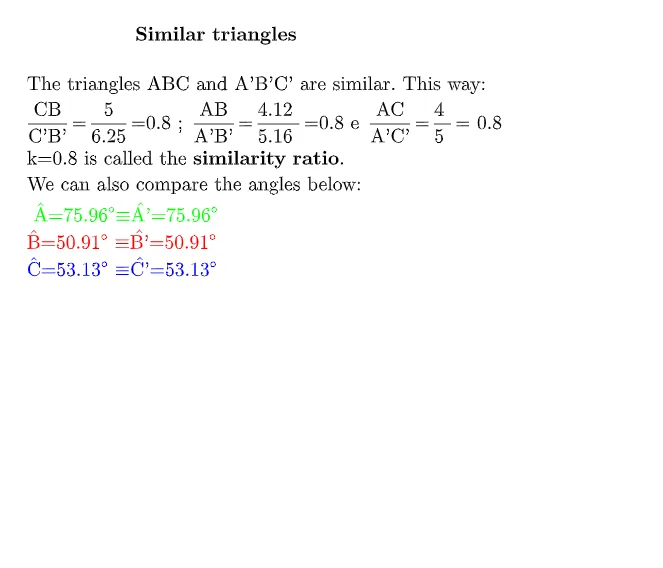
This example demonstrates the concept of triangle similarity, including definitions, similarity criteria (AA, SAS, SSS), and proofs. Key math concepts involve triangle similarity, angle relationships, and side ratios. GeoGebra commands like Polygon, Circle, Point, Angle, Ray, Rotate, Intersect, and Segment are used to construct the figures, with Slider animations and Locus features to illustrate dynamic similarity conditions. Suitable for high school geometry instruction and construction learning.
GeoGebra Commands & Parameters
Polygon(A, B, C) → pol1, c, a, bCircle(D_1, c) → d_2Circle(D_1, a) → e_2Point(e_2) → E_1Circle(E_1, b) → f_2Angle(pol1) → α, β, γPolygon(C, B, A) → pol3, a_1, c_1, b_1Ray(C', H) → iRotate(C', (-γ), C') → G'Rotate(H, (-γ), C') → H'Ray(G', H') → i'Point(i) → B'Ray(B', C') → jRotate(B', β, B') → I'Rotate(C', β, B') → G'_1Ray(I', G'_1) → j'Intersect(j', i') → A'Polygon(A', B', C') → pol5, k, l, mAngle(pol5) → ε, δ, ξSegment(C', B') → fSegment(B', A') → eSegment(A', C') → dSegment(A', C') → pSegment(C', B') → qSegment(B', A') → r
AI Drawing Prompt Reference
Draw triangle ABC, then rotate it around point C to create a similar triangle. Construct another similar triangle A'B'C' and label all angles and sides. Finally, connect the vertices to form a new triangle and label its angles.
The prompt above was compiled from the original drawing commands and is for reference only.