
Triangle Properties Based on Sides
Loading the math board and drawing, please wait…
In collections
Mathematics Form 1
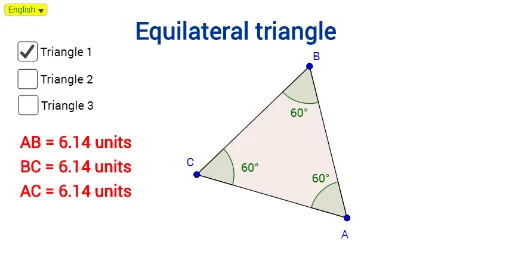
This example demonstrates the properties of triangles classified by their side lengths. It involves core mathematical concepts such as triangle classification (scalene, isosceles, equilateral), side relationships, angle relationships, the cosine theorem, rotation, and similarity transformations. The construction utilizes GeoGebra commands and objects like Segment, Circle, Intersect, LineBisector, Point, Distance, Polygon, Angle, SelectedIndex, and If. It is suitable for high school mathematics education, exploring and verifying theorems and properties of triangle classification, and deepening the understanding of geometric transformations.
GeoGebra Commands & Parameters
Segment(A, B) → aCircle(A, B) → cCircle(B, A) → dIntersect(c, d, 1) → CSegment(C, A) → bSegment(C, B) → eSegment(D, E) → fLineBisector(D, E) → gPoint(g) → FSegment(F, D) → hSegment(F, E) → iSegment(H, G) → jSegment(H, I) → kSegment(I, G) → lDistance(A, B) → ABDistance(B, C) → BCDistance(A, C) → ACDistance(D, E) → DEDistance(E, F) → EFDistance(D, F) → DFDistance(G, H) → GHDistance(H, I) → HIDistance(G, I) → GIPolygon(A, B, C) → poly1, c_1, a_1, b_1Polygon(D, E, F) → poly2, f_1, d_1, e_1Polygon(H, I, G) → poly3, g_1, h_1, i_1Angle(A, C, B) → αAngle(C, B, A) → βAngle(B, A, C) → γAngle(E, D, F) → δAngle(F, E, D) → εAngle(I, H, G) → ζAngle(H, G, I) → ηAngle(G, I, H) → θAngle(D, F, E) → ιSelectedIndex(Bahasa) → nnIf(nn ≟ 1, "units", "unit") → UTexIf(nn ≟ 1, "Equilateral triangle", "Segi tiga sama sisi") → text2If(nn ≟ 1, "Isosceles triangle", "Segi tiga sama kaki") → text3If(nn ≟ 1, "Scalene triangle", "Segi tiga tak sama kaki") → text5