
Triangle Inequality Open-Middle Problem: Circle Intersections & Distance Constra
Loading the math board and drawing, please wait…
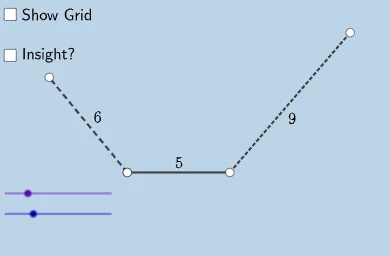
This example demonstrates how to visualize the triangle inequality by converting an “open middle” distance condition into a geometric region generated by circle intersections. It makes clear that for three points forming a (non-degenerate) triangle, the side lengths must satisfy the triangle inequality: the sum of two sides is greater than the third, and the difference of two sides is less than the third. Key concepts include point-to-point distance, constructing circles with radii equal to given lengths, and using intersections of such circles to represent where the inequality constraints hold (with open/strict boundaries). Construction highlights: the GeoGebra commands include Circle to build distance-defined circles, Point to represent centers and derived points, and Intersect to compute the intersection points that correspond to feasible configurations; Segment and Polygon are used to connect points and outline triangle/general quadrilateral structures; Textfield provides labels for key lengths/parameters to support logical comparison. Suitable for secondary to early undergraduate geometry, inequality visualization, and teaching/learning geometric construction and reasoning.
GeoGebra Commands & Parameters
Circle(A, a) → ePoint(e) → DSegment(A, D) → hPoint(e) → BCircle(B, b) → cPoint(c) → CCircle(A, P - a - b) → dPoint(c) → ESegment(B, E) → fPoint(d) → FSegment(A, F) → gIntersect(c, d, 2) → GCircle(A, Radius[d]) → kCircle(D, Radius[c]) → pIntersect(d, k, 1) → HIntersect(d, k, 1) → IIntersect(d, k, 1) → JIntersect(p, d) → K, L, ,Polygon(A, L, D) → t1, d_1, a_1, lPolygon(A, K, D) → t2, d_2, a_2, k_1Textfield(P) → InputBox1
AI Drawing Prompt Reference
Draw a visualization of the triangle inequality. Start with two fixed points as centers, draw two circles with given radii, and mark their intersection points. Pick a point on one circle, connect it to the other center with a segment, then draw a third circle centered at that point with another given radius, intersecting the second circle. Next, draw a circle centered at the first center with radius equal to the third circle's radius, and another circle centered at a point on the second circle with radius equal to the second circle's radius; mark their intersections. Connect these intersection points to the relevant centers with segments to form two triangles, and include a text input box to adjust parameters, illustrating that the sum of two sides is greater than the third and the difference is less.
The prompt above was compiled from the original drawing commands and is for reference only.