
Triangle Congruence Criteria by David
Loading the math board and drawing, please wait…
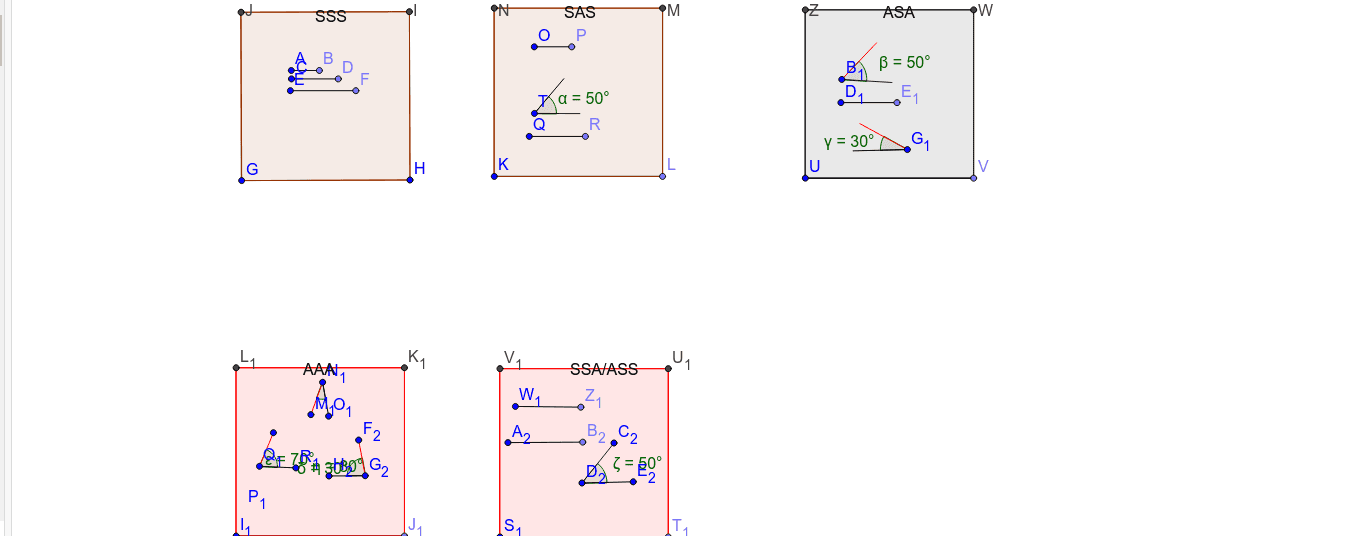
This example demonstrates the criteria for triangle congruence. It involves key mathematical concepts such as triangle congruence and logic. Using GeoGebra commands like Point, Segment, Polygon, etc., it constructs triangles that meet the congruence criteria. Suitable for middle school and above students to learn about geometric construction and the concept of congruent triangles.
GeoGebra Commands & Parameters
Point(Circle[A, 3]) → BSegment(A, B) → aPoint(Circle[C, 5]) → DSegment(C, D) → bPoint(Circle[E, 7]) → FSegment(E, F) → cPolygon(G, H, 4) → poly1, d, e, f, g, I, JDistance(H, d) → distanceHdPoint(Circle[K, 18]) → LSegment(K, L) → hPolygon(K, L, 4) → poly2, i, j, k, l, M, NPoint(Circle[O, 4]) → PSegment(O, P) → mPoint(Circle[Q, 6]) → RSegment(Q, R) → nRotate(S, 50*°, T) → S'Angle(S, T, S') → αSegment(T, S) → pSegment(T, S') → qPoint(Circle[U, 18]) → VSegment(U, V) → rPolygon(U, V, 4) → poly3, s, t, a_1, b_1, W, ZRotate(A_1, -50*°, B_1) → C_1Angle(C_1, B_1, A_1) → βSegment(A_1, B_1) → c_1Segment(C_1, B_1) → d_1Point(Circle[D_1, 6]) → E_1Segment(D_1, E_1) → e_1Rotate(F_1, 30*°, G_1) → H_1Angle(F_1, G_1, H_1) → γSegment(H_1, G_1) → f_1Segment(G_1, F_1) → g_1Point(Circle[I_1, 18]) → J_1Segment(I_1, J_1) → h_1Polygon(I_1, J_1, 4) → poly4, i_1, j_1, k_1, l_1, K_1, L_1Rotate(M_1, 30*°, N_1) → O_1Angle(M_1, N_1, O_1) → δSegment(N_1, M_1) → m_1Segment(O_1, N_1) → n_1Rotate(P_1, -70*°, Q_1) → R_1Angle(R_1, Q_1, P_1) → εSegment(P_1, Q_1) → p_1Segment(Q_1, R_1) → q_1Point(Circle[S_1, 18]) → T_1Segment(S_1, T_1) → r_1Polygon(S_1, T_1, 4) → poly5, s_1, t_1, a_2, b_2, U_1, V_1Point(Circle[W_1, 7]) → Z_1Segment(W_1, Z_1) → c_2Point(Circle[A_2, 8]) → B_2Segment(A_2, B_2) → d_2Rotate(C_2, -50*°, D_2) → E_2Angle(E_2, D_2, C_2) → ζSegment(D_2, C_2) → e_2Segment(D_2, E_2) → f_2Rotate(F_2, 80*°, G_2) → H_2Angle(F_2, G_2, H_2) → ηSegment(H_2, G_2) → g_2Segment(G_2, F_2) → h_2
AI Drawing Prompt Reference
Draw a set of diagrams illustrating triangle congruence criteria. Start with three base segments of lengths 3, 5, and 7 units. Then construct a quadrilateral and measure the distance from one side to the opposite side. Next, draw a segment of length 18 units and construct another quadrilateral. Create an angle of 50 degrees with its two sides. Then draw another 18-unit segment, construct a third quadrilateral, and create a 50-degree angle with its sides. After that, draw a 6-unit segment, construct a 30-degree angle with its sides, then draw an 18-unit segment, construct a fourth quadrilateral, and create a 30-degree angle. Finally, draw an 18-unit segment, construct a fifth quadrilateral, create a 70-degree angle, and draw a 7-unit segment. The overall figure demonstrates various side-length and angle combinations for triangle congruence.
The prompt above was compiled from the original drawing commands and is for reference only.