
Triangle Centers and Exploration
Loading the math board and drawing, please wait…
In collections
Besondere Punkte/Special Points
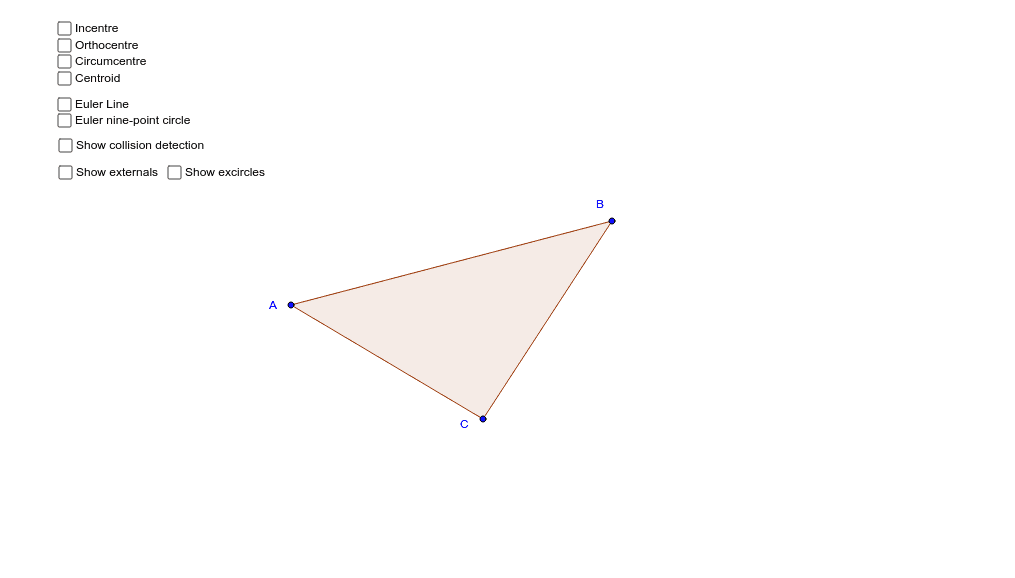
This example demonstrates the geometric properties of triangles, including the centroid, orthocenter, incenter, and circumcenter. Using GeoGebra commands such as Polygon, Midpoint, Line, etc., dynamic exploration of the triangle's center points and their properties is possible. Suitable for middle school and above students to learn geometric construction and related concepts.
GeoGebra Commands & Parameters
Polygon(A, B, C) → poly1, c, a, bMidpoint(b) → DMidpoint(a) → EMidpoint(c) → FLine(B, D) → dLine(E, A) → eLine(C, F) → fIntersect(d, e) → CentroidOrthogonalLine(B, b) → gOrthogonalLine(C, c) → hOrthogonalLine(A, a) → iIntersect(g, h) → OrthocentreAngularBisector(A, B, C) → jAngularBisector(C, A, B) → kAngularBisector(B, C, A) → lIntersect(j, k) → IncentreLineBisector(c) → mLineBisector(b) → nLineBisector(a) → pIntersect(m, n) → CircumcentreOrthogonalLine(Incentre, a) → qIntersect(q, a) → KCircle(Incentre, K) → rCircle(Circumcentre, B) → sLine(Orthocentre, Centroid) → a_1Circle(Circumcentre, C) → c_1OrthogonalLine(Incentre, a) → b_1Intersect(b_1, a) → GCircle(Incentre, G) → d_1Line(C, Centroid) → f_1Intersect(g, b) → HAngle(C, H, B) → αIntersect(i, a) → IIntersect(h, c) → JAngle(A, J, C) → βAngle(B, I, Orthocentre) → γAngle(A, F, Circumcentre) → δAngle(C, D, Circumcentre) → εAngle(B, E, Circumcentre) → ζAngle(B, C, Incentre) → ηAngle(Incentre, C, A) → θCircle(E, D, F) → k_1Segment(F, E) → m_1Segment(F, D) → n_1LineBisector(n_1) → p_1LineBisector(m_1) → q_1Intersect(p_1, q_1) → LMidpoint(Orthocentre, B) → MMidpoint(Orthocentre, C) → NMidpoint(Orthocentre, A) → OSegment(P, A) → r_1Segment(P, C) → s_1Segment(P, B) → t_1Angle(B, P, A) → ιAngle(A, P, C) → κAngle(C, P, B) → λLaTeX(μ, true, true) → text4LaTeX(ι, true, true) → text5LaTeX(κ, true, true) → text6LaTeX(λ, true, true) → text7AngularBisector(c, a) → a_2, b_2AngularBisector(c, b) → c_2, d_2AngularBisector(b, a) → e_2, f_2Intersect(a_2, c_2) → QIntersect(c_2, e_2) → RIntersect(a_2, e_2) → SOrthogonalLine(Q, c) → g_2OrthogonalLine(S, a) → h_2OrthogonalLine(R, b) → i_2Intersect(g_2, c) → TIntersect(h_2, a) → UIntersect(i_2, b) → VCircle(R, V) → k_2Circle(Q, T) → p_2Circle(S, U) → q_2Line(A, B) → j_2Line(C, A) → l_2Line(B, C) → m_2