
Triangle by Reflections: Exploring Congruence via Mirror
Loading the math board and drawing, please wait…
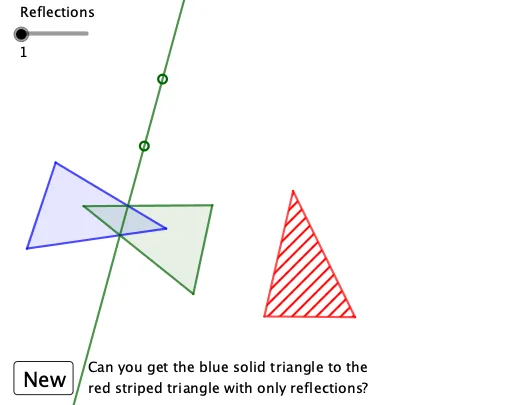
① This example demonstrates whether one triangle can be reflected onto another to show congruence, using dynamic geometry. ② Core math concepts include congruent triangles, reflection (axial symmetry), incircle and angle bisectors, random point generation, and geometric constraints. ③ Construction highlights: GeoGebra commands such as Polygon, RandomPointIn, Circle, Intersect, RandomElement, LineBisector, If, Mirror, and Line are used; key objects include triangles ABC and its reflected images A', B', C', incircle c, and various auxiliary lines and intersection points. ④ Suitable for middle school to high school students learning geometric transformations and congruence criteria, as well as for teachers creating interactive demonstrations or exploratory activities.
GeoGebra Commands & Parameters
Polygon(A, B, C) → t1, c, a, bPolygon(D, E, F, G) → q1, d, e, f, gRandomPointIn(q1) → HCircle(H, c) → hIntersect(PolyLine[D, E, F, G, D], h) → I, J, Q, R, U, VRandomElement(RemoveUndefined[{I, J, L, M}]) → KLineBisector(A, H) → iLineBisector(B, K) → jIntersect(i, j) → NIf(Defined[N], Rotate[C, Angle[A, N, H], N], Translate[C, H - A]) → OMirror(O, LineBisector[Segment[H, K]]) → O'RandomElement({O, O'}) → PPolygon(A', B', C') → t2, k, l, mLine(W, Z) → nMirror(A, n) → A'_1Mirror(B, n) → B'_1Mirror(C, n) → C'_1Polygon(A'_1, B'_1, C'_1) → t1', c'_1, a'_1, b'_1Line(A_1, B_1) → pMirror(A'_1, p) → C_1Mirror(B'_1, p) → D_1Mirror(C'_1, p) → E_1Polygon(C_1, D_1, E_1) → t1'', e_1, c_1, d_1Line(F_1, G_1) → qMirror(C_1, q) → H_1Mirror(D_1, q) → I_1Mirror(E_1, q) → J_1Polygon(H_1, I_1, J_1) → t1''', j_1, h_1, i_1
AI Drawing Prompt Reference
Draw a triangle ABC and then generate its two reflected triangles A'B'C' and A''B''C''. First, randomly generate a point H, use H as the center to create a circle, and find the intersection points I, J, Q, R, U, V with the polygon DEFG. Randomly select one of these points as K, then create angle bisectors i and j with A and H as the axes, and find their intersection point N as the rotation center. Rotate C around N to get O, then mirror O across the perpendicular bisector of line segment HK to get O'. Randomly choose one from O and O' as P, and create triangle A'B'C'. Next, create a line n and mirror A, B, C across n to get A'_1, B'_1, C'_1, and create triangle A'_1B'_1C'_1. Then, create a line p and mirror A'_1, B'_1, C'_1 across p to get C_1, D_1, E_1, and create triangle C_1D_1E_1. Finally, create a line q and mirror C_1, D_1, E_1 across q to get H_1, I_1, J_1, and create triangle H_1I_1J_1.
The prompt above was compiled from the original drawing commands and is for reference only.