
Triangle Angle Sum Theorem Demo
Loading the math board and drawing, please wait…
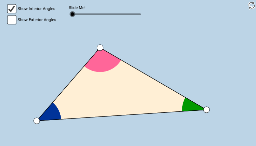
This example uses transformational geometry tools to demonstrate the Triangle Angle Sum Theorem, involving core concepts like triangle interior angles and geometric transformations. It constructs a triangle and shows its angle sum is 180 degrees using commands like Segment, Polygon, Angle, Rotate, and Dilate, suitable for middle school and above students learning geometric transformations in proofs.
GeoGebra Commands & Parameters
Segment(B, C) → eSegment(C, A) → fMin(f, e) → mSegment(A, B) → dMin(d, f) → oMin(m, o) → uPolygon(A, B, C) → poly1, c, a, bRay(A, B) → hRay(B, C) → iRay(C, A) → jCircle(C, (0.25 * u)) → pCircle(A, (0.25 * u)) → qCircle(B, (0.25 * u)) → rIntersect(p, f) → D,Intersect(p, e, 1) → EIntersect(r, e, 1) → FIntersect(r, d, 1) → GIntersect(q, d, 1) → HIntersect(q, f, 1) → IIntersect(r, h, 2) → JIntersect(q, j, 2) → KIntersect(p, i, 2) → LMidpoint(f) → MMidpoint(e) → NCircleSector(A, H, I) → sCircleSector(B, F, G) → tCircleSector(C, D, E) → c_1Angle(A, C, B) → αCircleSector(C, E, D) → d_1CircleSector(A, I, H) → e_1CircleSector(B, G, F) → f_1Min(d, e) → nRotate(s, If[0 < l ≤ 1, (((-l) * 180))°, -180°], M) → s'Rotate(A, If[0 < l ≤ 1, (((-l) * 180))°, -180°], M) → A'Segment(M, A') → a_1Rotate(H, -180°, M) → H'Line(H', C) → b_1Rotate(B, If[0 < l ≤ 1, ((l * 180))°, 180°], N) → B'Rotate(t, If[0 < l ≤ 1, ((l * 180))°, 180°], N) → t'Segment(N, B') → g_1Segment(C, M) → h_1Segment(M, A) → i_1Segment(C, N) → j_1Segment(N, B) → k_1Rotate(A, If[0 < l ≤ 1, ((l * 180))°, -180°], M) → A'_1Rotate(B, If[0 < l ≤ 1, (((-l) * 180))°, -180°], N) → B'_1Segment(N, B'_1) → l_1Segment(M, A'_1) → m_1Rotate(e_1, If[0 < l ≤ 1, ((l * 180))°, -180°], M) → p_1Rotate(f_1, If[0 < l ≤ 1, (((-l) * 180))°, -180°], N) → q_1CircleSector(C, L, D) → r_1CircleSector(A, K, H) → s_1CircleSector(B, J, F) → t_1CircleSector(A, H, K) → c_2CircleSector(B, F, J) → d_2CircleSector(C, D, L) → e_2Dilate(A, 1 - v, C) → A'_2Dilate(B, 1 - v, C) → B'_2Vector(A, A'_2) → wVector(B, B'_2) → u_1Translate(s_1, w) → f_2CircleArc(A, K, H) → g_2Translate(t_1, u_1) → h_2CircleArc(B, J, F) → k_2Translate(c_2, w) → p_2CircleArc(A, H, K) → q_2Translate(d_2, u_1) → r_2CircleArc(B, F, J) → s_2
AI Drawing Prompt Reference
Draw a triangle and demonstrate that its interior angles sum to 180 degrees. Start by constructing the three sides of the triangle. Then, at each vertex, draw a small circle with radius proportional to the shortest side length, intersecting the two adjacent sides at two points each. Use these intersection points to create circular sectors at each vertex, representing the interior angles. Finally, rotate the sectors at two vertices by 180 degrees around the midpoints of their opposite sides, so they move to the third vertex and fit together with its sector, visually proving the angle sum.
The prompt above was compiled from the original drawing commands and is for reference only.