
Trapezoids and the Harmonic Mean
Loading the math board and drawing, please wait…
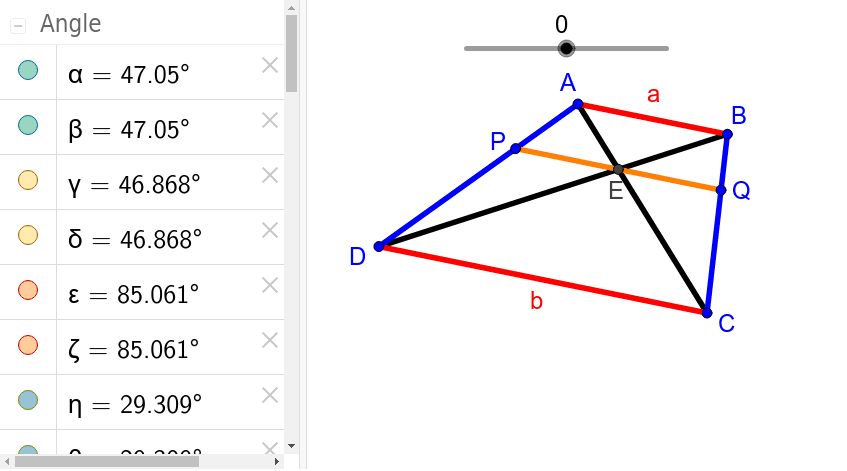
This example demonstrates the geometric relationship between trapezoids and the harmonic mean, involving core concepts like trapezoid properties, harmonic mean definition, similarity transformations, histograms, and piecewise functions. Construction highlights GeoGebra commands: Line, Point, Segment, Intersect, and Angle. Suitable for high school mathematics education, illustrating the application of geometric transformations combined with statistical characteristics.
GeoGebra Commands & Parameters
Line(D, C) → fLine(A, f) → gPoint(g) → BLine(D, A) → hLine(B, C) → iSegment(A, C) → jSegment(B, D) → kSegment(D, C) → bSegment(A, D) → mSegment(B, C) → nSegment(A, B) → aIntersect(j, k) → ELine(E, b) → qIntersect(h, q) → PIntersect(i, q) → QSegment(P, Q) → rSegment(E, Q) → lSegment(P, E) → pAngle(C, D, A) → αAngle(E, P, A) → βAngle(A, E, P) → γAngle(E, C, D) → δAngle(B, Q, E) → εAngle(Q, C, D) → ζAngle(Q, E, B) → ηAngle(C, D, E) → θ
AI Drawing Prompt Reference
Draw a trapezoid ABCD with AD and BC parallel. Then draw the midsegment PQ of the trapezoid, and the line segments connecting the intersection point E of the diagonals to the vertices. Finally, label and measure the angles α, β, γ, δ, ε, ζ, and η within the trapezoid, as well as the length of the midsegment PQ.
The prompt above was compiled from the original drawing commands and is for reference only.