
Trapezoids and Kites: Geometric Construction and Properties by Genia Kennedy
Loading the math board and drawing, please wait…
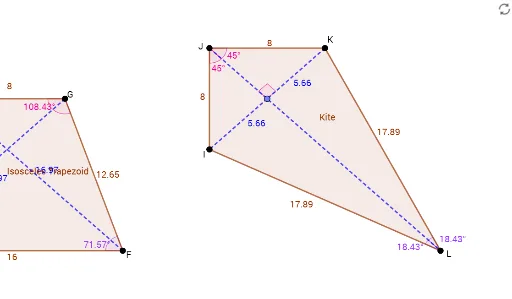
① This GeoGebra example dynamically demonstrates the construction of trapezoids and kites, visually illustrating the relationships among sides, angles, and diagonals of these two quadrilateral types. ② Core mathematical concepts include quadrilateral classification, properties of parallel lines, symmetry of isosceles trapezoids and kites, angle sum theorems, and the properties of midsegments (median lines). ③ Construction highlights: using the Polygon command to create polygons q1, q2, q3; defining vertices A, B, C, D via Point; connecting sides a, b, c, d with Segment; labeling angles α, β, γ, δ with Angle; and constructing midpoints E, F, G, H and segments m, n, showcasing rigorous geometric construction. ④ Suitable for middle and high school students learning plane geometry, this resource serves as an interactive tool for classroom demonstration or self-study, aiding in understanding the criteria and properties of special quadrilaterals, and can also inspire teachers to create customized geometry lessons.
GeoGebra Commands & Parameters
Polygon(A, B, C, D) → q1, a, b, c, dPolygon(E, F, G, H) → q2, e, f, g, hAngle(A, D, C) → αAngle(D, C, B) → βAngle(C, B, A) → γAngle(B, A, D) → δAngle(E, H, G) → εAngle(H, G, F) → ζAngle(G, F, E) → ηAngle(F, E, H) → θPolygon(I, J, K, L) → q3, i, j, k, lSegment(J, L) → mSegment(E, G) → pSegment(H, F) → qPoint(m) → MSegment(K, M) → nSegment(M, I) → rAngle(K, J, M) → ιAngle(I, J, M) → κAngle(K, L, M) → λAngle(I, L, M) → μPoint(d) → NPoint(b) → OSegment(N, O) → sAngle(J, M, K) → ν
AI Drawing Prompt Reference
Draw a dynamic illustration showing the geometric construction of trapezoids and kites, illustrating the relationships among sides, angles, and diagonals, including properties of parallel lines, symmetry of isosceles trapezoids and kites, angle sum theorems, and midsegments. Construct two quadrilaterals, label their sides and angles, then create midpoints and connecting segments, finally showing the relationships of midsegments and midpoints.
The prompt above was compiled from the original drawing commands and is for reference only.