
Trapezoid Properties Investigation by Catherine A Eagen
Loading the math board and drawing, please wait…
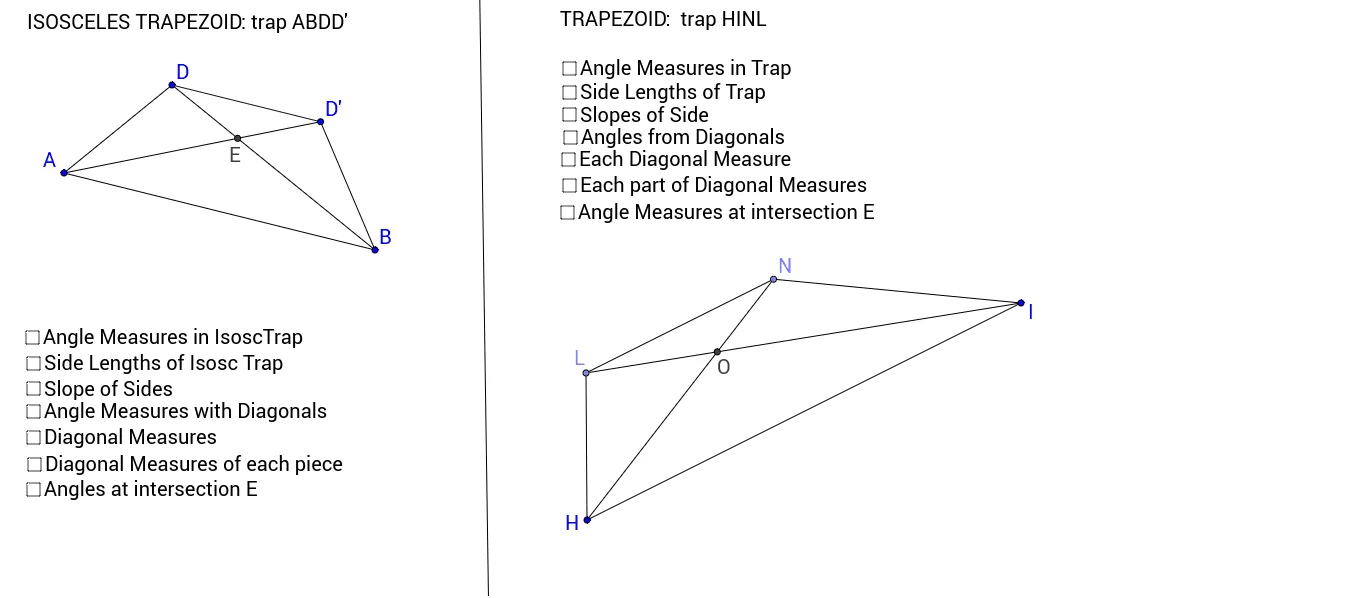
This example demonstrates the properties of trapezoids, involving core mathematical concepts such as polygons, angles, distances, slopes, etc. Construction highlights include using commands like Segment, LineBisector, Intersect, Mirror, Angle, Distance, Slope, Line, OrthogonalLine, Point, Circle, CircleArc, and objects like text1, text2, A, B, a, b, C, D, c, D', d, e, α, β, γ, δ, f, distanceAD, TextAD, distanceDD', TextDD', distanceD'B, TextD'B, distanceBA, TextBA, g, m, m_1, h, i, j, E, ε, ζ, η, θ, ι, κ, λ, μ. Suitable for middle school and above mathematics education, focusing on geometric construction and property exploration.
GeoGebra Commands & Parameters
Segment(A, B) → aLineBisector(a) → bIntersect(b, a) → CSegment(A, D) → cMirror(D, b) → D'Segment(D', B) → dSegment(D', D) → eAngle(B, A, D) → αAngle(A, D, D') → βAngle(D, D', B) → γAngle(D', B, A) → δDistance(A, D) → distanceADDistance(D, D') → distanceDD'Distance(D', B) → distanceD'BDistance(B, A) → distanceBASlope(e) → mSlope(a) → m_1Segment(A, D') → iSegment(B, D) → jIntersect(i, j) → EAngle(E, A, D) → εAngle(A, D, E) → ζAngle(E, D, D') → ηAngle(D, D', E) → θAngle(E, D', B) → ιAngle(D', B, E) → κAngle(E, B, A) → λAngle(B, A, E) → μDistance(A, E) → distanceAEDistance(E, D') → distanceED'Distance(B, E) → distanceBEDistance(E, D) → distanceEDDistance(A, D') → distanceAD'Distance(D, B) → distanceDBLine(F, G) → pLine(H, I) → qOrthogonalLine(H, q) → rOrthogonalLine(I, q) → sPoint(q) → JCircle(H, J) → tIntersect(t, r, 2) → KCircleArc(H, J, K) → c_1Point(c_1) → LLine(L, q) → a_1Intersect(a_1, s) → MSegment(L, M) → b_1Point(b_1) → NSegment(H, L) → d_1Segment(L, N) → e_1Segment(N, I) → f_1Segment(H, I) → g_1Angle(N, I, H) → νAngle(I, H, L) → ξAngle(H, L, N) → οAngle(L, N, I) → ρDistance(H, L) → distanceHLDistance(L, N) → distanceLNDistance(N, I) → distanceNIDistance(I, H) → distanceIHSlope(e_1) → m_2Slope(g_1) → m_3Segment(L, I) → h_1Segment(N, H) → i_1Intersect(h_1, i_1) → OAngle(D', E, D) → σAngle(B, E, D') → τAngle(H, L, O) → υAngle(O, L, N) → ϕAngle(L, N, O) → χAngle(N, I, O) → ψAngle(O, N, I) → ωAngle(O, I, H) → α_1Angle(I, H, O) → β_1Angle(O, H, L) → γ_1Distance(L, O) → distanceLODistance(O, N) → distanceONDistance(O, I) → distanceOIDistance(O, H) → distanceOHDistance(L, I) → distanceLIDistance(N, H) → distanceNHAngle(L, O, H) → δ_1Angle(N, O, L) → ε_1
AI Drawing Prompt Reference
Draw a trapezoid ABCD with vertices A, B, C, and D. Start by drawing line segments AB and AD, then find the perpendicular bisector of AB and let it intersect AB at point C. Next, draw line segment CD and reflect point D to get D' on the perpendicular bisector. Measure and calculate the lengths and angles of the trapezoid, such as AD, DD', D'B, and BA. Finally, use auxiliary lines and arcs to explore the properties of the trapezoid, including angles ε, ζ, η, θ, ι, κ, λ, and μ.
The prompt above was compiled from the original drawing commands and is for reference only.