
Transversals and Parallel Lines: Angle Relationships Practice
Loading the math board and drawing, please wait…
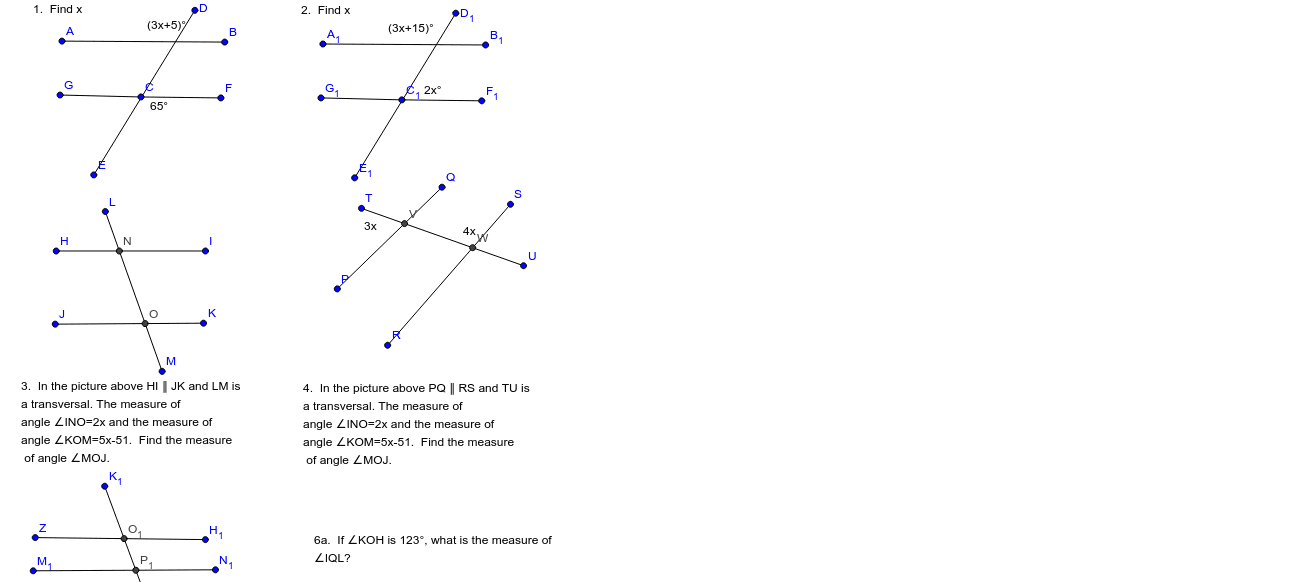
① This example demonstrates the angle relationships formed when a transversal intersects two parallel lines, including corresponding angles, alternate interior angles, and consecutive interior angles, with interactive practice problems. ② Core math concepts include properties of parallel lines, angle pairs formed by a transversal (corresponding angles equal, alternate interior angles equal, same-side interior angles supplementary), and solving for unknown angles using these relationships. ③ Construction highlights: The GeoGebra construction uses the Segment command to draw parallel lines and transversals, the Intersect command to mark intersection points (A, B, C, D, etc.), and text objects (text1, text2, text3, etc.) to display angle measures or prompts. Multiple sets of lines (a, b, c, d and their primed versions) are included to generate various configurations. ④ Suitable for middle school geometry instruction or self-study, this resource helps reinforce angle relationships and can serve as a template for classroom exercises or homework.
GeoGebra Commands & Parameters
Segment(A, B) → bSegment(D, E) → dSegment(F, C) → aSegment(C, G) → cSegment(A_1, B_1) → b_1Segment(D_1, E_1) → d_1Segment(F_1, C_1) → a_1Segment(C_1, G_1) → c_1Segment(H, I) → eSegment(J, K) → fSegment(L, M) → gIntersect(e, g) → NIntersect(f, g) → OSegment(P, Q) → hSegment(R, S) → iSegment(T, U) → jIntersect(h, j) → VIntersect(i, j) → WSegment(Z, H_1) → kSegment(I_1, J_1) → lSegment(K_1, L_1) → mSegment(M_1, N_1) → nIntersect(k, m) → O_1Intersect(m, n) → P_1Intersect(l, m) → Q_1
AI Drawing Prompt Reference
Draw two sets of parallel lines intersected by a transversal, each set consisting of two parallel segments and one oblique transversal crossing them, creating multiple intersection points. Label the angles at these intersections and show relationships such as corresponding angles, alternate interior angles, and consecutive interior angles. Additionally, draw three separate pairs of intersecting lines, each pair crossing at a single point to form vertical or adjacent angles for practice. Arrange all groups clearly for easy observation of different angle relationships.
The prompt above was compiled from the original drawing commands and is for reference only.