
Translation of Linear and Exponential Functions
Loading the math board and drawing, please wait…
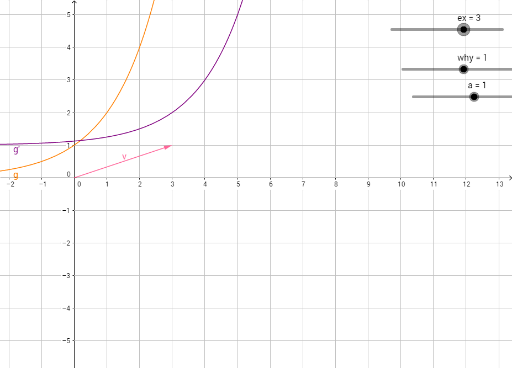
①This GeoGebra example dynamically illustrates how linear and exponential functions change under vector translation, making the geometric meaning of function shifts visually clear. ②Core mathematical concepts include translation transformations of function graphs, properties of linear and exponential functions, derivatives and area, as well as sequences and integers in the context of shifting. ③Construction highlights: the Vector command creates a translation vector, the Translate command shifts function objects (such as f, g and their derivatives f', g'), sliders a and variable v control translation parameters, and the original and translated graphs along with area regions are displayed. ④Suitable for high school to early college students to understand function transformations and introductory calculus, and serves as an interactive teaching tool for demonstrating how translation affects function shapes and derivatives.
GeoGebra Commands & Parameters
Vector((ex, why)) → vTranslate(f, v) → f'Translate(g, v) → g'
AI Drawing Prompt Reference
Create a coordinate plane with a linear function and an exponential function, along with their derivative curves. Use a slider to control a translation vector originating from the origin. Translate all four curves (the two functions and their derivatives) by this vector, showing the shifted versions in distinct colors. Add semi-transparent shaded regions between each original function and its translated counterpart to highlight the area change, illustrating how translation affects function shapes and derivatives.
The prompt above was compiled from the original drawing commands and is for reference only.