
Translation and Rhombus Integral Calculation
Loading the math board and drawing, please wait…
In collections
geometriadinamica.es
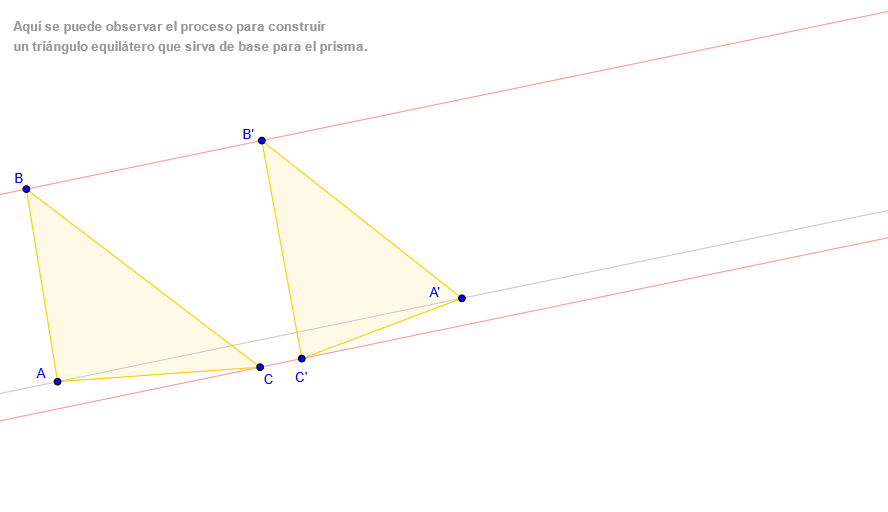
This example demonstrates the geometric relationship between translation transformation and rhombus integral calculation. It involves core concepts like translation, rhombus properties, integral computation, square root operations, and arithmetic operations. Construction highlights include commands such as Line, Polygon, Point, OrthogonalLine, Intersect, Circle, AngularBisector, and Ray. Suitable for high school mathematics teaching and geometric construction learning.
GeoGebra Commands & Parameters
Line(A, A') → dLine(C, d) → eLine(B, d) → fPolygon(A, B, C) → poly1, c, a, bPoint(f) → B'Point(e) → C'Polygon(A', B', C') → poly2, c', a', b'Point(d) → A''OrthogonalLine(A'', d) → pIntersect(e, p) → IIntersect(f, p) → HCircle(I, H) → rAngularBisector(e, f) → q,Intersect(p, q) → JIntersect(r, q) → L, MRay(A'', M) → sOrthogonalLine(M, s) → tIntersect(t, f) → B''Intersect(e, t) → C''Polygon(A'', C'', B'') → poly5, n, d_2, o
AI Drawing Prompt Reference
Draw a diagram containing two translated rhombuses, including two similar rhombuses, a circle, an angular bisector, and two intersection points. The two similar rhombuses have side lengths that are twice and half of the original rhombus, respectively. The circle's center is at the intersection of the two similar rhombuses, and its radius is equal to the side length of the original rhombus. The angular bisector is located at the common angle of the two similar rhombuses. Construct the diagram in a specific order, starting with the original rhombus, then drawing the two similar rhombuses based on the original rhombus, followed by the circle and angular bisector, and finally the two intersection points.
The prompt above was compiled from the original drawing commands and is for reference only.