
Transforming the Sine Function (All Transformations)
Loading the math board and drawing, please wait…
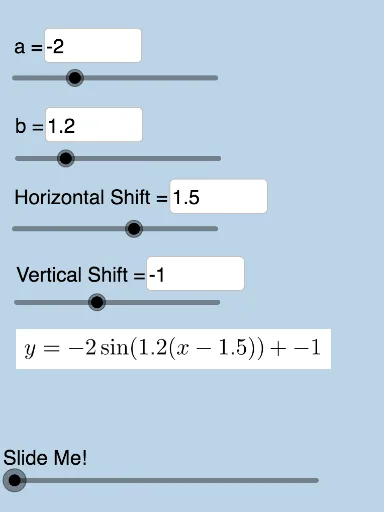
This example demonstrates the sine function graph and all its transformations. It involves core math concepts like sine function, geometric transformations, and coordinate systems. Construction highlights include commands like Textfield, FractionText, Numerator, Denominator, Dilate, LCM, Vector, Translate, Distance, Intersect, and objects a, c, d, f, etc. Suitable for high school and above students to understand function transformation rules.
GeoGebra Commands & Parameters
Textfield(c) → InputBox1FractionText(1.25) → text1Numerator(b_1) → eDenominator(b_1) → gDilate(A, If[0 < h ≤ 1, 1 - h, 0], B) → A'LCM(4, g) → iDilate(A, If[2 < h ≤ 3, 3 - h, 0], C) → A'_1Vector(A, A'_1) → uTranslate(q, u) → q_1Dilate(E, If[1 < h ≤ 2, 2 - h, 0], D) → E'Vector(E, E') → vTranslate(E, u) → E'_1Translate(D, u) → D'Vector(E'_1, D') → wDilate(G, If[6 < h ≤ 7, 7 - h, 0], I) → G'Vector(G, G') → mTranslate(F, m) → F'Translate(G, m) → G'_1Translate(C, m) → C'Distance(C, C') → distanceCC'Distance(F', I) → distanceF'IDistance(A, C) → distanceACDistance(J, K) → a_1Intersect(k_1, l_1) → SIntersect(l_1, j_1) → TDilate(S, If[3 < h ≤ 4, 4 - h, 0], T) → S'Vector(S, S') → v_1Distance(S, T) → distanceSTDilate(S, If[4 < h ≤ 5, 5 - h, 0], T) → S'_1Dilate(D', If[4 < h ≤ 5, 5 - h, 0], U) → D''Vector(D', D'') → w_1Translate(P, w_1) → P'Translate(D', w_1) → D''_1Vector(P', D''_1) → c_1Distance(P', D''_1) → distanceP'D''1Dilate(U, If[5.5 < h ≤ 6.5, 6.5 - h, 0], V) → U'Vector(M, U') → lDistance(M, U') → distanceMU'Dilate(A_1, If[7 < h ≤ 8, 8 - h, 0], Z) → B_1Vector(A_1, B_1) → nTranslate(t_1, n) → rTranslate(M, n) → M'Translate(U', n) → U''Vector(M', U'') → sDistance(U'', M') → distanceU''M'Distance(A_1, B_1) → distanceA1B1Textfield(d) → InputBox2Textfield(a) → InputBox3Textfield(b) → InputBox4
AI Drawing Prompt Reference
Draw the sine function and all its transformations, including vertical and horizontal scaling, translation, and reflection. Start by drawing the sine function graph, then apply various transformations such as translating point A along vector u to get q₁, translating point E along vector v to get E₁, and translating point D along vector w to get D'. Calculate the distances between various points. Finally, use reflection and scaling transformations to get the final graph, demonstrating the rules of sine function transformations.
The prompt above was compiled from the original drawing commands and is for reference only.