
Transformations of Quadratics
Loading the math board and drawing, please wait…
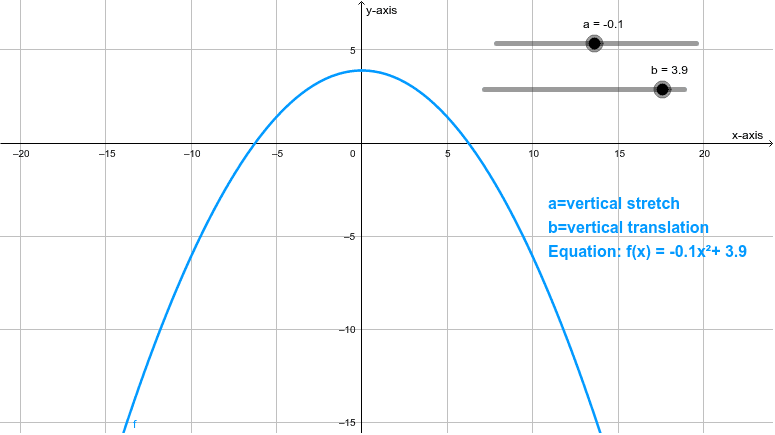
This GeoGebra example dynamically illustrates how quadratic functions change under geometric transformations such as translation, scaling, and reflection, linking algebraic parameters to visual graph behavior. Core mathematical concepts include the standard and vertex forms of quadratic functions, the roles of parameters a, h, and k, and the effects of geometric transformations on function graphs. The construction uses objects a, b, f, and text2, where a and b likely serve as sliders controlling transformation parameters, f is the quadratic function graph, and text2 displays the current function expression or transformation notes. By adjusting sliders, users observe real-time changes in the parabola. This resource is suitable for middle and high school students learning function transformations, graph properties, or for teachers demonstrating these concepts in class, as well as for self-directed exploration.
GeoGebra Commands & Parameters
Numeric a(-0.1)Numeric b(3.9)f(x) = (a * x^(2)) + b