
Transformation of Quadratics: Shifts, Stretches, and Reflections
Loading the math board and drawing, please wait…
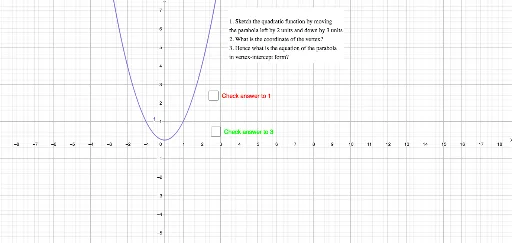
This GeoGebra example demonstrates how quadratic functions transform under parameter changes, including horizontal/vertical translations, vertical stretches/compressions, and reflections. The core mathematical concepts involve the standard and vertex forms of quadratics, the effects of coefficients on the vertex, axis of symmetry, and roots, as well as the geometric interpretation of function transformations. Construction highlights: the base function f is defined as a quadratic, sliders a and b control transformation parameters, and text objects text1 and text2 dynamically display the current equation and key features; the transformed function g updates in real time. This resource is ideal for middle and high school mathematics, supporting lessons on functions, transformations, and graphing, and encourages exploratory learning to connect algebraic parameters with visual graph changes.
GeoGebra Commands & Parameters
y = x^(2)Boolean a(false)y = (x - 2)^(2) - 3Boolean b(false)
AI Drawing Prompt Reference
Draw a demonstration of quadratic function transformations. Start with a basic upward-opening parabola with its vertex at the origin. Then draw a second parabola shifted horizontally right by 2 units and vertically down by 3 units, so its vertex is at (2, -3). Use different colors for the two curves. Add two adjustable sliders to control the horizontal and vertical shifts, and display the current function equation. Label the vertices and axes of symmetry for both parabolas to clearly show the effect of translation on the graph.
The prompt above was compiled from the original drawing commands and is for reference only.