
TR KAY - Fraction Division Visualization
Loading the math board and drawing, please wait…
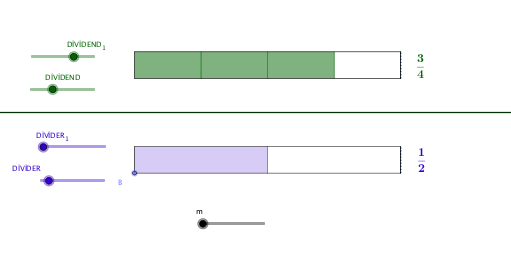
This GeoGebra example demonstrates a visual and geometric construction of fraction division, turning the abstract arithmetic operation into an interactive diagram. The core mathematical concept is fraction division, where dividing by a fraction is equivalent to multiplying by its reciprocal, and the construction integrates elements such as equilateral triangles, orthocenters, quadrilaterals, and bar charts to represent the division process. Key construction steps involve using GeoGebra commands like Point, Segment, Sequence, and Polygon to create points, segments, sequences, and polygons; defining the dividend (DİVİDEND) and divisor (DİVİDER) along with their variants; and organizing geometric objects through multiple lists (list1, list2, liste2, etc.) and loop variables (i, j, k, l, m). The use of equilateral triangles and orthocenter properties aids in the geometric layout, and the final result is presented as a bar chart or bar graph. This resource is suitable for middle school mathematics (grades 6-8) for teaching fraction operations, and can be used by teachers to create interactive lessons that help students grasp the geometric meaning and rules of fraction division.
GeoGebra Commands & Parameters
Point(yAxis) → APoint(yAxis) → BSegment(C, F) → aSegment(E, F) → bSegment(E, B) → cSegment(B, C) → dSegment(A, G) → eSegment(G, H) → fSegment(D, H) → gSegment(A, D) → hSequence((x(A) + (i * x(G) / DİVİDEND), y(A)), i, 1, DİVİDEND) → list1Sequence((x(D) + (i * x(H) / DİVİDEND), y(D)), i, 1, DİVİDEND) → list2Sequence((x(B) + (i * x(E) / DİVİDER), y(B)), i, 1, DİVİDER) → liste2Sequence((x(C) + (i * x(F) / DİVİDER), y(C)), i, 1, DİVİDER) → liste3Polygon(A, D, Element[list2, DİVİDEND_1], Element[list1, DİVİDEND_1]) → liste5, liste5_2, liste5_3, liste5_4, liste5_5Sequence(Segment[Element[liste2, i], Element[liste3, i]], i, 1, DİVİDER) → liste4Sequence(Segment[Element[list1, i], Element[list2, i]], i, 1, DİVİDEND) → liste1Polygon(B, C, Element[liste3, DİVİDER_1], Element[liste2, DİVİDER_1]) → çokgen1, i, j, k, lSequence((x(A) + (i * x(G) / m), y(A)), i, 1, m) → liste6Sequence((x(D) + (i * x(H) / m), y(D)), i, 1, m) → liste7Sequence(Segment[Element[liste6, i], Element[liste7, i]], i, 1, m) → liste8Sequence((x(B) + (i * x(E) / m), y(B)), i, 1, m) → liste9Sequence((x(C) + (i * x(F) / m), y(C)), i, 1, m) → liste10Sequence(Segment[Element[liste9, i], Element[liste10, i]], i, 1, m) → liste11