
Thiessen Polygons Generated from Sample Points
Loading the math board and drawing, please wait…
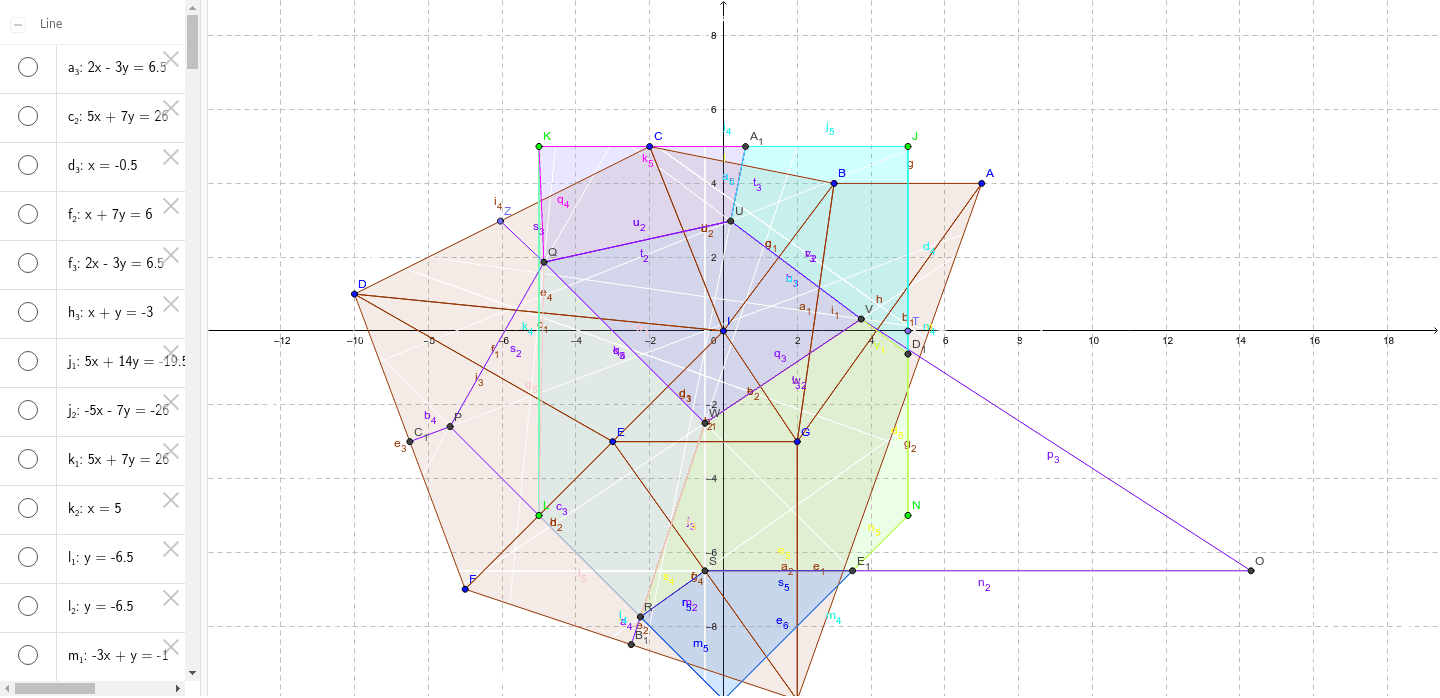
This example demonstrates how to generate Thiessen Polygons based on a set of sample points. It involves core mathematical concepts such as polygon construction, vectors, and 2D coordinate geometry. Key GeoGebra commands used include Polygon, Segment, LineBisector, Intersect, and Point. Suitable for high school mathematics teaching or geometric construction learning.
GeoGebra Commands & Parameters
Polygon(C, B, I) → poly1, i, c, bPolygon(A, B, G) → poly2, g, a_1, b_1Polygon(I, G, B) → poly3, b_2, i_1, g_1Polygon(G, H, A) → poly4, a_2, g_2, hPolygon(E, I, G) → poly5, g_3, e, i_2Polygon(E, H, G) → poly6, g_4, e_1, h_1Polygon(F, E, H) → poly7, h_2, f, e_2Polygon(D, F, E) → poly8, e_3, d, f_1Polygon(I, D, E) → poly9, e_4, i_3, d_1Polygon(C, D, I) → poly10, i_4, c_1, d_2Segment(L, M) → jSegment(K, L) → kSegment(K, J) → lSegment(N, J) → mSegment(M, N) → nLineBisector(D, F) → pLineBisector(D, E) → qLineBisector(F, E) → rLineBisector(D, I) → sLineBisector(E, I) → tLineBisector(A, H) → j_1LineBisector(A, G) → k_1LineBisector(G, H) → l_1Intersect(j_1, k_1) → OIntersect(p, q) → PIntersect(q, s) → QLineBisector(F, H) → m_1LineBisector(H, E) → n_1Intersect(r, m_1) → RLineBisector(H, E) → p_1LineBisector(E, G) → q_1LineBisector(G, H) → r_1Intersect(l_1, n_1) → SLineBisector(H, G) → s_1LineBisector(H, A) → t_1LineBisector(A, G) → c_2LineBisector(B, G) → f_2LineBisector(G, A) → j_2LineBisector(A, B) → k_2Point(m) → TLineBisector(H, G) → l_2Segment(R, S) → m_2Segment(S, O) → n_2LineBisector(C, B) → p_2LineBisector(C, I) → q_2LineBisector(I, B) → r_2Intersect(p_2, q_2) → USegment(P, Q) → s_2Segment(Q, U) → t_2LineBisector(G, I) → a_3Intersect(f_2, r_2) → VSegment(U, V) → b_3Segment(R, P) → c_3LineBisector(E, G) → d_3LineBisector(G, I) → f_3LineBisector(I, E) → h_3Intersect(t, m_1) → WSegment(R, W) → j_3Segment(Q, W) → k_3Segment(W, V) → l_3LineBisector(H, G) → m_3LineBisector(G, A) → n_3Segment(V, O) → p_3Segment(V, W) → q_3Segment(V, U) → r_3Point(i_4) → ZSegment(Q, Z) → s_3Intersect(p_2, l) → A_1Segment(U, A_1) → t_3Intersect(m_1, e_2) → B_1Segment(R, B_1) → a_4Intersect(p, e_3) → C_1Segment(P, C_1) → b_4Polygon(M, N, J, K, L) → poly11, m_4, n_4, j_4, k_4, l_4Polygon(K, A_1, U, Q) → poly12, k_5, a_5, u, q_4Intersect(k_2, r_2) → D_1Polygon(D_1, J, A_1, U, V) → poly13, d_4, j_5, a_6, u_1, vIntersect(t, l_1) → E_1Polygon(D_1, N, E_1, S, R, W, V) → poly14, d_5, n_5, e_5, s_4, r_4, w, v_1Polygon(E_1, M, R, S) → poly15, e_6, m_5, r_5, s_5Polygon(R, W, Q, L) → poly16, r_6, w_1, q_5, l_5Polygon(W, V, U, Q) → poly17, w_2, v_2, u_2, q_6