
The Donkey Triangle: SSA Congruence Ambiguity
Loading the math board and drawing, please wait…
In collections
Unit 4 Triangle Congruence Theorems
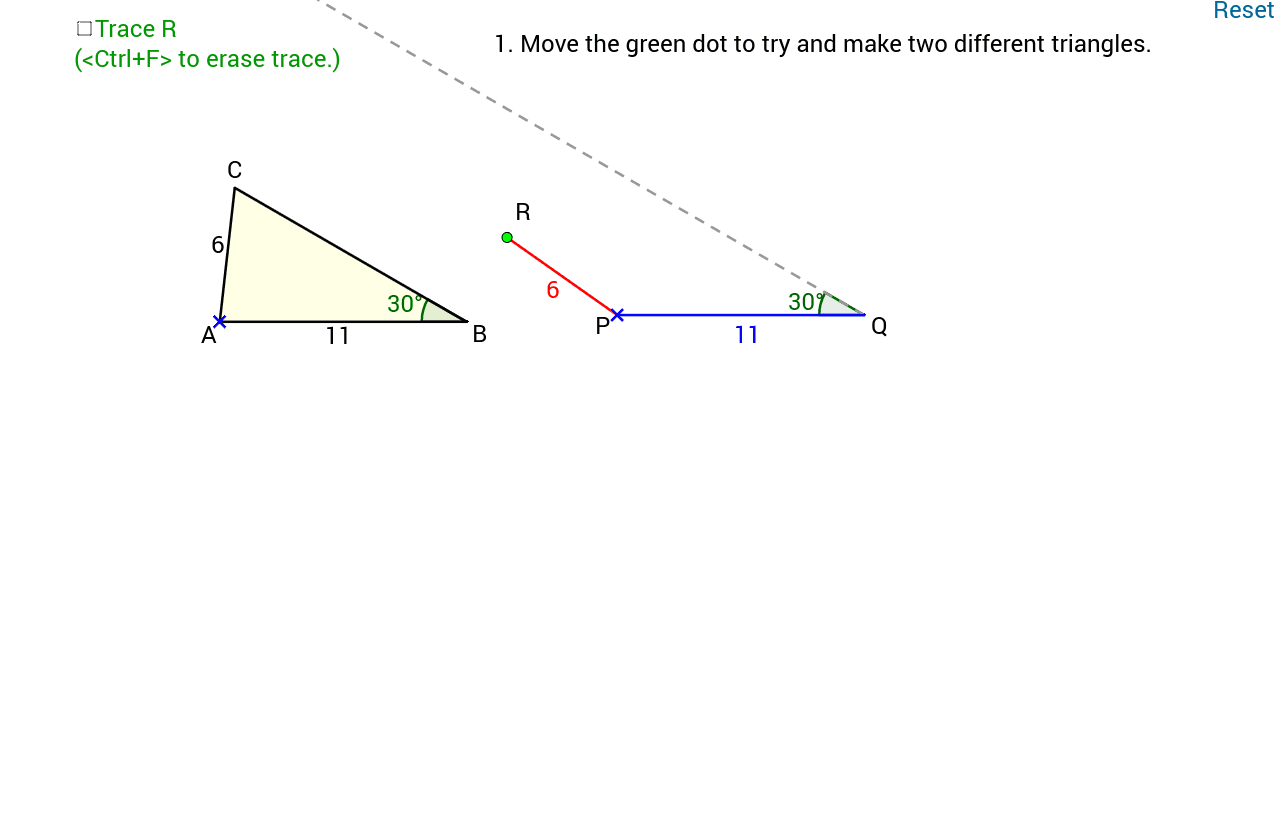
This example illustrates the ambiguous case of SSA congruence: given two sides and a non‑included angle, zero, one, or two distinct triangles can be constructed, showing the SSA ambiguity. The core mathematical concepts involve the SSA ambiguous case, triangle congruence criteria, the law of sines, and side‑angle relationships. The GeoGebra construction uses commands such as Point, Rotate, Angle, Intersect, Polygon, Segment, Ray, and If, defining objects like H, I, J, A, B, A', etc., to dynamically build the figure. It is suitable for high‑school geometry and trigonometry classes and introductory college geometry courses, providing an interactive way to explore the limitations of SSA conditions.
GeoGebra Commands & Parameters
Point(Semicircle[(x(H) - 4, y(H)), (x(H) + 4, y(H))]) → JRotate(A, 330°, B) → A'Angle(A', B, A) → αIntersect(Circle[A, 6], Line[B, A']) → C_1, CPolygon(A, B, C) → poly1, c, a, bPoint(Ray[D, (x(D) + 1, y(D))]) → ESegment(D, E) → dPoint(Ray[F, (x(F) + 1, y(F))]) → GSegment(F, G) → eAngle(J, H, I) → βRotate(P, (-γ), Q) → P'Angle(P', Q, P) → δPoint(Circle[P, d]) → RRotate(I, (-γ), H) → I'Angle(I', H, I) → εSegment(I, H) → gSegment(J, H) → hRay(Q, P') → iIntersect(OrthogonalLine[R, i], i) → KPolygon(P, Q, R) → poly2, r, p, qIf(Distance[R, K] < 0.01, true, false) → on