
The daisy: a flower for fractions by Daniel Mentrard
Loading the math board and drawing, please wait…
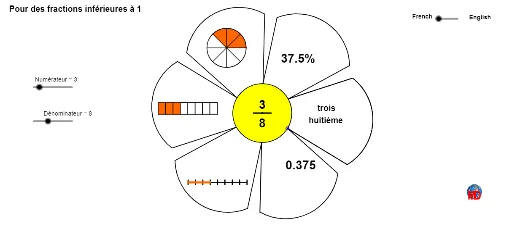
This example dynamically demonstrates the construction of a daisy flower, visually linking fractions with geometric shapes. It involves core math concepts like fractions, complex numbers, conic sections, squares, median values, and inequalities. GeoGebra commands and objects used include Circle, Point, Rotate, Midpoint, CircumcircleArc, Segment, Sequence, Text, Polygon, and CircleSector. Suitable for high school and above, it helps learners understand the connection between fractions, complex numbers, and geometric constructions.
GeoGebra Commands & Parameters
Circle(A, R) → cPoint(c) → BRotate(B, 1.0471975511965976, A) → HRotate(B, 0.5236, A) → GMidpoint(G, H) → CMidpoint(C, H) → ICircumcircleArc(D, E, F) → d_1CircumcircleArc(B, G, H) → eSegment(B, D) → aSegment(H, F) → bSequence(Rotate[liste1, ((i * 2) * π / 6), A], i, 0, 6) → liste2Midpoint(E, G) → JMidpoint(J, G) → KText(Element[listnum, Numérateur]) → texte1Text(Element[listden, Dénominateur]) → texte2Rotate(K, -1.0471975511965976, A) → K'Rotate(K, 1.0471975511965976, A) → K'_1Rotate(K, 2.0943951023931953, A) → MCircle(L, R / 1.5) → fSequence(Rotate[N, ((i * 2) * π / Dénominateur), L], i, 0, Dénominateur) → liste3Sequence(Segment[L, Element[liste3, i]], i, 1, Length[liste3]) → liste4Rotate(L, 1.0471975511965976, A) → PSequence(Q + (0, 1) + (i * Vector[Q, O] / Dénominateur), i, 0, Dénominateur) → liste6Polygon(S, T, O, Q) → poly1, s, t, o, qSequence(Q + (i * Vector[Q, O] / Dénominateur), i, 0, Dénominateur) → liste5Sequence(Segment[Element[liste5, i], Element[liste6, i]], i, 1, Length[liste6]) → liste7Polygon(Q, Element[liste5, Numérateur + 1], Element[liste6, Numérateur + 1], S) → poly2, h, i, l, mRotate(P, 1.0471975511965976, A) → P'Sequence(Z + (0, 0.2) + (i * Vector[Z, W] / Dénominateur), i, 0, Dénominateur) → liste8Sequence(Z - (0, 0.2) + (i * Vector[Z, W] / Dénominateur), i, 0, Dénominateur) → liste9Segment(Z, W) → jSequence(Segment[Element[liste8, i], Element[liste9, i]], i, 1, Length[liste8]) → liste10Segment(Z, Z + (Numérateur * Vector[Z, W] / Dénominateur)) → kCircleSector(L, N, Element[liste3, Numérateur + 1]) → gSegment(A - (0.75, 0), A + (0.75, 0)) → pCircle(A, R) → rText(Element[listnumang, Numérateur]) → texte9Text(Element[lisdenang, Dénominateur]) → texte10
AI Drawing Prompt Reference
Draw a daisy flower composed of geometric shapes to demonstrate the connection between fractions and complex numbers. Start with a central circle, rotate points around it to form petals, connecting them with arcs and segments. Label each petal with corresponding fractions. The construction should highlight rotation, midpoints, and arcs, with a harmonious color scheme suitable for mathematical education.
The prompt above was compiled from the original drawing commands and is for reference only.