
Thales' Theorem Dynamic Demonstration + Sequel
Loading the math board and drawing, please wait…
In collections
Circles (Theorems)
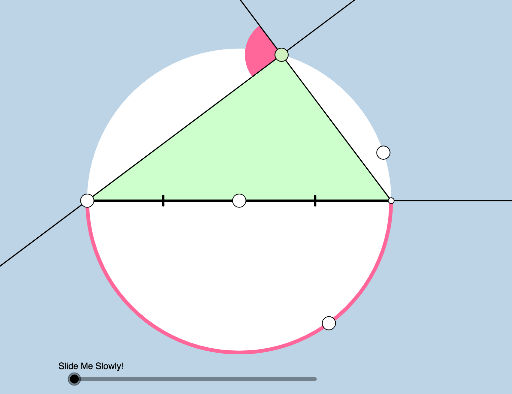
This example dynamically demonstrates Thales' theorem problem, showcasing geometric relationships through interactive illustrations. It involves core math concepts like circles, triangles, angles, rotation, and transformation. Construction highlights include commands such as Circle, Point, Line, Intersect, Rotate, and Translate. Suitable for high school mathematics education to visually understand geometric theorems and transformations.
GeoGebra Commands & Parameters
Circle(A, B) → cPoint(c) → CLine(C, A) → aIntersect(c, a, 2) → DCircleArc(A, C, D) → dCircleArc(A, D, C) → ePoint(e) → ESegment(C, D) → hDilate(C, If[0 < b ≤ 1, 1 - b, 0], A) → C'Segment(C, C') → iDilate(A, If[1 < b ≤ 2, 2 - b, 0], D) → A'Segment(A, A') → jRotate(C, If[2 < b ≤ 3, ((-(b - 2)) * π), (-π)], A) → C'_1Rotate(C', If[2 < b ≤ 3, ((-(b - 2)) * π), (-π)], A) → C''Segment(C'_1, C'') → i'Rotate(C, If[3 < b ≤ 4, ((b - 3) * π), π], A) → C'_2CircleArc(A, C, C'_2) → kDilate(D, If[5 < b ≤ 6, 6 - b, 0], E) → D'Segment(D, D') → fRay(D, E) → gPoint(g) → FRay(E, F) → lDilate(C, If[5 < b ≤ 6, 6 - b, 0], E) → C'_3Segment(C, C'_3) → mMin({m, f}) → nCircle(E, (0.2 * n)) → pIntersect(p, l) → G,Intersect(c, m, 1) → HIntersect(p, m) → I,CircleSector(E, G, I) → qRotate(q, If[6.5 < b ≤ 7.5, ((b - 6.5) * π / 2), π / 2], E) → q'Point(cc) → JLine(C, D) → rOrthogonalLine(J, r) → sIntersect(s, r) → KLine(C, E) → tOrthogonalLine(J, t) → f_1Intersect(t, f_1) → LLine(K, L) → g_1Line(J, E) → h_1Intersect(g_1, h_1) → MAngle(A, M, J) → αLine(A, M) → i_1Circle(C, 1) → c_1Circle(E, 1) → d_1Intersect(d_1, t, 2) → NIntersect(c_1, t, 1) → ORay(E, N) → j_1Ray(C, O) → k_1Dilate(J, If[8 < b ≤ 9, 9 - b, 0], K) → J'Segment(J, J') → l_1Dilate(E, If[9 < b ≤ 10, 10 - b, 0], K) → E'Vector(E, E') → uTranslate(q', u) → q''Line(E, r) → m_1Point(m_1) → PAngle(D, E, P) → βRotate(q'', If[10 < b ≤ 11, ((b - 10) * β), β], K) → q'''Mirror(J, r) → J'_1Dilate(K, If[9 < b ≤ 10, 10 - b, 0], J'_1) → K'Segment(K, K') → n_1Dilate(J, If[11 < b ≤ 12, 12 - b, 0], L) → J'_2Segment(J, J'_2) → p_1Dilate(E, If[12 < b ≤ 13, 13 - b, 0], L) → E'_1Vector(E, E'_1) → vTranslate(q', v) → q''_1Dilate(J, If[13 < b ≤ 14, 14 - b, 0], E) → J'_3Segment(J, J'_3) → q_1Dilate(K, If[14 < b ≤ 15, 15 - b, 0], M) → K'_1Segment(K, K'_1) → r_1Dilate(M, If[15 < b ≤ 16, 16 - b, 0], L) → M'Segment(M, M') → s_1Circle(A, 1) → e_1Circle(M, 1) → t_1Intersect(t_1, c, 1) → QIntersect(t_1, i_1) → R, SIntersect(e_1, i_1) → T, UDilate(A, If[16 < b ≤ 17, 17 - b, 0], M) → A'_1Segment(A, A'_1) → a_1Ray(M, S) → b_1Ray(A, T) → f_2Dilate(E, If[17 < b ≤ 18, 18 - b, 0], M) → E'_2Vector(E, E'_2) → wTranslate(q', w) → q''_2Line(E, f_2) → g_2Point(g_2) → VAngle(V, E, L) → δRotate(q''_2, If[18 < b ≤ 19, ((-(b - 18)) * δ), (-δ)], M) → c_2Polygon(C, D, E) → poly1, e_2, c_3, d_2CircleArc(A, E, C) → h_2CircleArc(A, D, E) → k_2CircleArc(A, C, D) → p_2Polygon(C, D, E) → poly2, e_3, c_4, d_3Circle(C, 1) → q_2Circle(D, 1) → r_2Intersect(r_2, a) → A_1, B_1Ray(D, B_1) → i_2