
Symmetry Game: Exploring Polygon Mirror Transformations
Loading the math board and drawing, please wait…
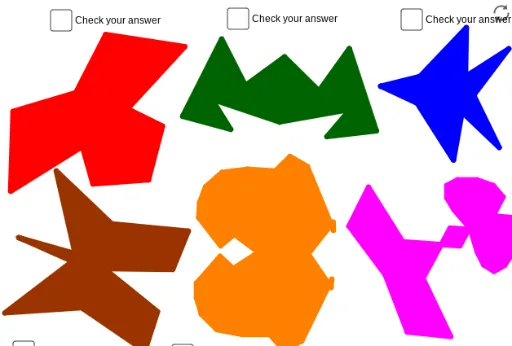
① This interactive 'Symmetry Game' demonstrates how polygons change under mirror (axial symmetry) transformations, visually showing the correspondence between shapes on both sides of a symmetry axis. ② Core mathematical concepts include axial symmetry, geometric transformations (reflection), polygon properties, and connections to logarithms, tangent functions, and scalene triangles. ③ Construction highlights: using GeoGebra commands Polygon to create multiple polygons (poly1, poly2, poly3) and Mirror to reflect points (A through S) and segments (a through r), generating symmetric figures with objects including points, segments, and polygons. ④ Suitable for middle school geometry lessons or gamified math learning, helping students understand symmetry rules and explore how different shapes (e.g., quadrilaterals, scalene triangles) behave under reflection.
GeoGebra Commands & Parameters
Polygon(A, B, C, D, E, F) → poly1, a, b, c, d, e, fPolygon(G, H, I, J, K, L, M) → poly2, g, h, i, j, k, l, mPolygon(N, O, P, Q, R, S) → poly3, n, o, p, q, r, sPolygon(T, U, V, W, Z, A_1, B_1) → poly4, t, u, v, w, z, a_1, b_1Polygon(C_1, E_1, O_1, P_1, Q_1, R_1, F_1, H_1, I_1, J_1, K_1, L_1, M_1, N_1) → poly5, c_1, n_1, o_1, p_1, q_1, r_1, e_1, f_1, h_1, i_1, j_1, k_1, l_1, m_1Polygon(G_1, S_1, E_2, F_2, G_2, H_2, I_2, J_2, T_1, U_1, V_1, W_1, Z_1, B_2, C_2, D_2) → poly6, g_1, d_2, e_2, f_2, g_2, h_2, i_2, j_2, s_1, t_1, u_1, v_1, w_1, z_1, b_2, c_2Mirror(A, f) → A'Mirror(B, f) → B'Mirror(C, f) → C'Mirror(D, f) → D'Mirror(E, f) → E'Mirror(F, f) → F'Polygon(A', B', C', D', E', F') → poly1', a', b', c', d', e', f'Mirror(G, k) → G'Mirror(H, k) → H'Mirror(I, k) → I'Mirror(J, k) → J'Mirror(K, k) → K'Mirror(L, k) → L'Mirror(M, k) → M'Polygon(G', H', I', J', K', L', M') → poly2', g', h', i', j', k', l', m'Mirror(N, n) → N'Mirror(O, n) → O'Mirror(P, n) → P'Mirror(Q, n) → Q'Mirror(R, n) → R'Mirror(S, n) → S'Polygon(N', O', P', Q', R', S') → poly3', n', o', p', q', r', s'Mirror(T, v) → T'Mirror(U, v) → U'Mirror(V, v) → V'Mirror(W, v) → W'Mirror(Z, v) → Z'Mirror(A_1, v) → A_2Mirror(B_1, v) → K_2Polygon(T', U', V', W', Z', A_2, K_2) → poly4', t', u', v', w', z', a_2, k_2Mirror(C_1, r_1) → L_2Mirror(E_1, r_1) → M_2Mirror(F_1, r_1) → N_2Mirror(H_1, r_1) → O_2Mirror(I_1, r_1) → P_2Mirror(J_1, r_1) → Q_2Mirror(K_1, r_1) → R_2Mirror(L_1, r_1) → S_2Mirror(M_1, r_1) → T_2Mirror(N_1, r_1) → U_2Mirror(O_1, r_1) → V_2Mirror(P_1, r_1) → W_2Mirror(Q_1, r_1) → Z_2Mirror(R_1, r_1) → A_3Polygon(L_2, M_2, V_2, W_2, Z_2, A_3, N_2, O_2, P_2, Q_2, R_2, S_2, T_2, U_2) → poly5', l_2, u_2, v_2, w_2, z_2, a_3, m_2, n_2, o_2, p_2, q_2, r_2, s_2, t_2Mirror(G_1, h_2) → B_3Mirror(S_1, h_2) → C_3Mirror(T_1, h_2) → D_3Mirror(U_1, h_2) → E_3Mirror(V_1, h_2) → F_3Mirror(W_1, h_2) → G_3Mirror(Z_1, h_2) → H_3Mirror(B_2, h_2) → I_3Mirror(C_2, h_2) → J_3Mirror(D_2, h_2) → K_3Mirror(E_2, h_2) → L_3Mirror(F_2, h_2) → M_3Mirror(G_2, h_2) → N_3Mirror(H_2, h_2) → O_3Mirror(I_2, h_2) → P_3Mirror(J_2, h_2) → Q_3Polygon(B_3, C_3, L_3, M_3, N_3, O_3, P_3, Q_3, D_3, E_3, F_3, G_3, H_3, I_3, J_3, K_3) → poly6', b_3, k_3, l_3, m_3, n_3, o_3, p_3, q_3, c_3, d_3, e_3, f_3, g_3, h_3, i_3, j_3Segment(R_3, S_3) → d_1Segment(T_3, U_3) → r_3Segment(V_3, W_3) → s_3Segment(Z_3, A_4) → t_3Segment(B_4, D_1) → a_4Segment(C_4, D_4) → b_4
AI Drawing Prompt Reference
Draw a hexagon ABCDEF and another hexagon GHIJKL, then perform mirror transformations on these hexagons using lines f, k, and n as axes of symmetry to generate new hexagons A'B'C'D'E'F' and G'H'I'J'K'L'. Next, use line v as the axis of symmetry to mirror hexagon TUVWXYZ and generate a new hexagon T'U'V'W'Z'A_2K_2. Finally, use line r_1 as the axis of symmetry to mirror hexagon C_1E_1O_1P_1Q_1R_1S_1 and generate a new hexagon L_2M_2N_2O_2P_2Q_2R_2S_2.
The prompt above was compiled from the original drawing commands and is for reference only.