
Symmetry Exercises for Kids: Mirror and Segment Construction
Loading the math board and drawing, please wait…
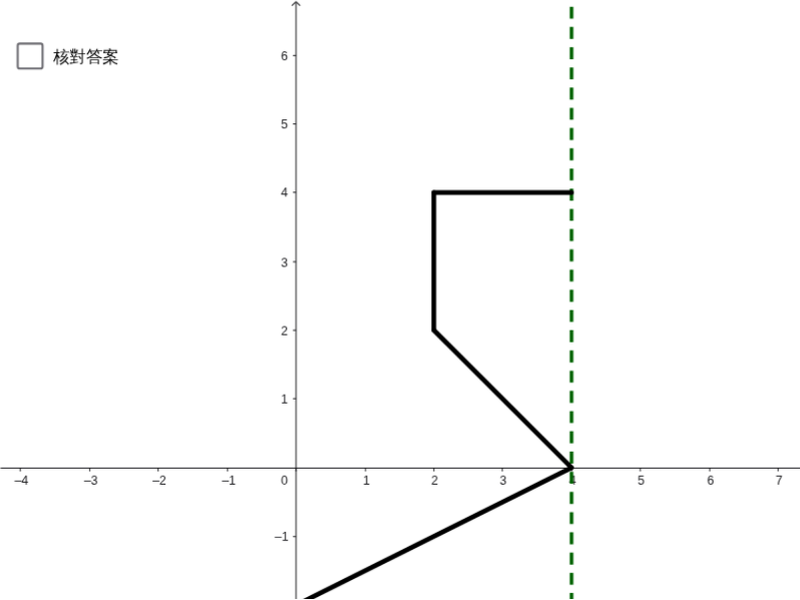
① This GeoGebra example presents a symmetry exercise designed for children, using mirror and segment tools to visually demonstrate the reflection of shapes across a line. ② The core mathematical concept is axial symmetry (mirror symmetry), involving the correspondence of points, segments, and triangles under reflection, with potential extensions to algebra and logarithmic functions for broader visualization. ③ Construction highlights: from the summary, commands include Line, Mirror, and Segment, creating objects such as X, Y, P₁, A₁–H₁, Q₁, and their mirrored counterparts (P', A'–H', Q'₁), along with multiple segments (b₁–s) to form a complete symmetric exercise environment. ④ Suitable for elementary to early middle school students, this serves as an interactive tool for grasping symmetry, and as a template for teachers to design engaging geometric activities that enhance spatial reasoning and manipulation skills.
GeoGebra Commands & Parameters
Line(X, Y) → a_1Mirror(P_1, a_1) → P'Mirror(A_1, a_1) → A'Mirror(B_1, a_1) → B'Mirror(C_1, a_1) → C'Mirror(D_1, a_1) → D'Mirror(E_1, a_1) → E'Mirror(F_1, a_1) → F'Mirror(G_1, a_1) → G'Mirror(H_1, a_1) → H'Mirror(Q_1, a_1) → Q'_1Segment(P_1, A_1) → b_1Segment(A_1, B_1) → c_1Segment(B_1, C_1) → d_1Segment(C_1, D_1) → e_1Segment(D_1, E_1) → f_1Segment(E_1, F_1) → g_1Segment(F_1, G_1) → h_1Segment(G_1, H_1) → i_1Segment(H_1, Q_1) → jSegment(P', A') → kSegment(A', B') → lSegment(B', C') → mSegment(C', D') → nSegment(D', E') → pSegment(E', F') → qSegment(F', G') → rSegment(G', H') → sSegment(H', Q'_1) → tLine(X, Y) → a
AI Drawing Prompt Reference
Draw a vertical line as the axis of symmetry. On one side, place a polyline shape consisting of several points connected in sequence, including a start point, intermediate turning points, and an end point. Reflect each point across the line to obtain corresponding points on the other side, then connect these reflected points with segments to form a mirror-image polyline. Finally, connect each original point to its reflected counterpart with segments to show the correspondence. The whole figure demonstrates axial symmetry clearly.
The prompt above was compiled from the original drawing commands and is for reference only.