
Symmetries Made Using Lists: Six Groups of Triangles with Slider Interaction
Loading the math board and drawing, please wait…
In collections
MalinC's GeoGebra-book
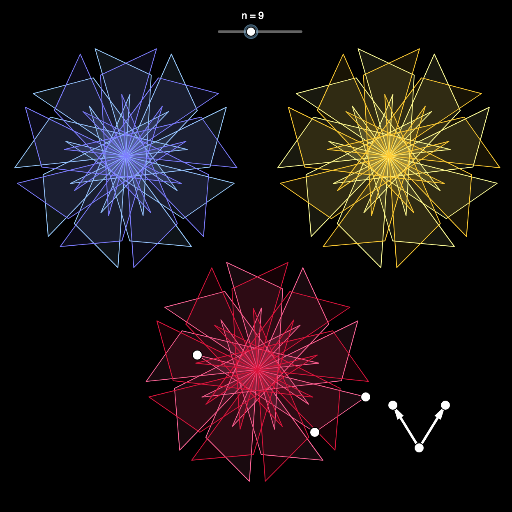
① This example demonstrates how to create a complex symmetric pattern composed of 6n triangles organized in six lists, using translation vectors and a slider for dynamic adjustment. ② Core mathematical concepts include 2D vectors, translation transformations, symmetry, and batch construction via the Sequence command, along with triangle types (e.g., scalene triangles) and a visual link to differential equations/calculus ideas. ③ Construction highlights: GeoGebra commands Sequence and Vector are used, defining points A, B, C and slider n; vectors u and v drive translations, while lists s0 through s5 organize the six triangle groups; dragging points or changing the slider alters the pattern's symmetry in real time. ④ Suitable for upper secondary to early university mathematics, especially for lessons on geometric transformations, vector applications, and dynamic math experiments, as well as for exploring symmetric patterns in design.
GeoGebra Commands & Parameters
Sequence(Polygon[Rotate[A, ((2 * π / n) * i), (0, 0)], Rotate[B, ((2 * π / n) * i), (0, 0)], Rotate[C, ((2 * π / n) * i), (0, 0)]], i, 0, n - 1) → s0Sequence(Mirror[Element[s0, i], yAxis], i, 1, n) → s1Vector(D, E) → uVector(D, F) → vSequence(Translate[Element[s0, i], Vector[(5 * u)]], i, 1, n) → s2Sequence(Translate[Element[s1, i], Vector[(5 * u)]], i, 1, n) → s3Sequence(Translate[Element[s0, i], Vector[(5 * v)]], i, 1, n) → s4Sequence(Translate[Element[s1, i], Vector[(5 * v)]], i, 1, n) → s5
AI Drawing Prompt Reference
Create a symmetric pattern composed of 6 groups of triangles, with each group containing 6n triangles. Adjust the value of n using a slider to change the symmetry of the pattern. Use points A, B, C and vectors u, v for rotations and translations, and construct six triangle groups s0 to s5 with sequence commands. Finally, apply mirroring and translation operations to complete the pattern.
The prompt above was compiled from the original drawing commands and is for reference only.