
Symmetric Geometry of e(x) and Ln(x)
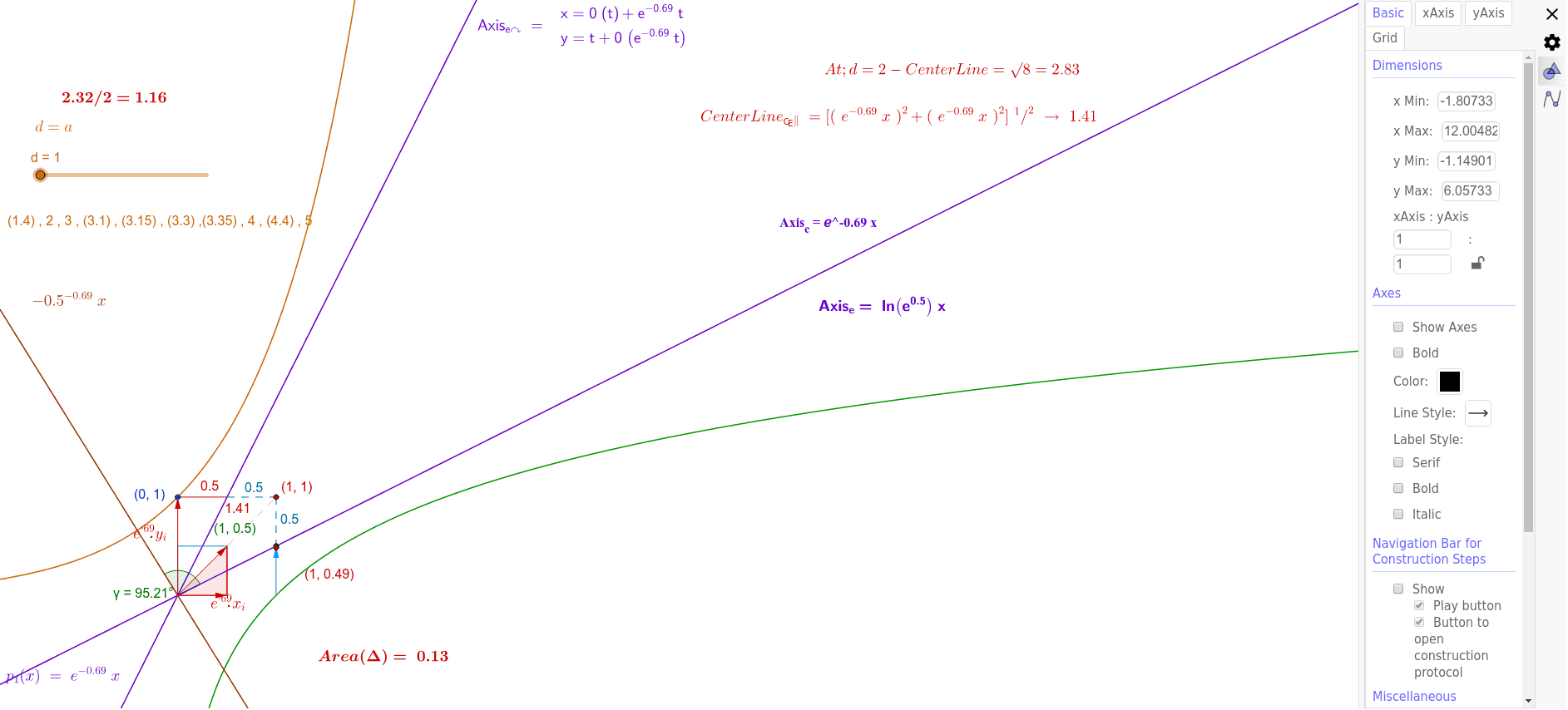
Loading the math board and drawing, please wait…
This example demonstrates the symmetric geometric relationship and mapping division between e(x) and Ln(x). It involves core mathematical concepts such as function graphs, symmetry, and calculus derivatives and integrals. GeoGebra commands and objects like Intersect, Point, Segment, Angle, Vector, Polygon, CircleArc, Mirror, Semicircle, and Line are used in the construction. Suitable for high school and above students studying function graphs, symmetry, and calculus, or for mathematical teaching demonstrations.
GeoGebra Commands & Parameters
Intersect(h, p_1, 1) → APoint(xAxis) → BSegment(A, B) → aPoint(p_1) → CSegment(A, C) → bAngle(B, A, C) → αVector((d, 0)) → uVector((0, d)) → vVector((d, 0), (d, f)) → p_2Vector((d, 0), (d, d)) → wVector((d, d)) → iPoint(r) → EPoint(s) → FSegment(F, E) → ePoint(w) → GPoint(w) → HPoint(p_2) → ISegment(H, I) → jSegment(A, F) → mPolygon(A, E, F) → poly1, f_2, a_1, e_1Point(s_1) → JCircleArc(A, F, J) → c_1Point(c_1) → KSegment(E, K) → b_1Segment(A, K) → d_1Mirror(p_1, f_2) → kIntersect(r_1, e, (1.0282309415854138, 0.027839793150316806)) → LIntersect(s_1, b_1, (0.027839320364406284, 1.0282304554524269)) → MSemicircle(M, L) → g_1CircleArc(A, L, M) → h_1Segment(L, M) → lLine(G, b_1) → i_1Intersect(s_1, i_1, (-4.8603231200479E-7, 0.9999995139678061)) → NIntersect(i_1, k) → OSegment(N, O) → j_1Segment(O, G) → k_1Segment(G, H) → l_1Intersect(r_1, j, (2.0500000000000003, 0.717839793150317)) → PSegment(P, H) → m_1Point(k) → QPoint(p_1) → RSegment(A, Q) → q_1Segment(A, R) → t_1Angle(R, A, Q) → βSegment(A, G) → a_2Point(g_2) → SSegment(A, S) → b_2Angle(C, A, S) → γIntersect(κ'', d_1, (-0.0004737290858993674, 0.4802952763533173)) → TPoint(l) → UIntersect(κ'', l, (0.41533431711823054, 0.640735828993262)) → VSegment(U, V) → c_2
AI Drawing Prompt Reference
Draw the exponential function e(x) and logarithmic function ln(x) showing their intersection in the first quadrant. Construct a perpendicular from the intersection point to the x-axis creating a vertical segment. Take a point on the logarithm curve and form angles with the intersection and a point on the x-axis. Create several vectors representing coordinate transformations. Select points on both function curves and connect them to form polygons. Create circular arcs with centers on the logarithm curve, then select points on these arcs and form new line segments. Reflect the exponential curve across a line to obtain a symmetric curve. Find intersection points between the reflected curve and related line segments, then use these points to construct additional arcs and lines. Measure multiple angles including the angle at the intersection point. The overall construction demonstrates the symmetric geometric relationship and mapping division between exponential and logarithmic functions.
The prompt above was compiled from the original drawing commands and is for reference only.